


You've Heard the Word "Cancer": What Grade, Stage and Prognosis Actually Mean
Alastair Greenway
BVM&S MRCVS

A cancer diagnosis is serious. It is not, by itself, a death sentence, and plenty of pets go on to live good lives, sometimes for years, after one. What happens next depends far more on the particular details of this cancer than on the word your vet used, and those details are what this page is about.
Most people take in very little of what the vet says straight after the word lands. That's normal. So this is here to give you a handful of plain terms, the ones that will make your next conversation make sense, so you can ask useful questions rather than lie awake guessing. You don't need to become an oncologist. You just need to follow the plan.
"Cancer" is not one disease
The word covers dozens of different diseases that behave in completely different ways. A small, low-grade mast cell tumour on your dog's skin, caught early and lifted off, has almost nothing in common with an aggressive haemangiosarcoma in the spleen, except the word on the leaflet. The first can often be cured with a single operation. The second is one we have to be most honest about from the start.
That's the reason a general "how long does a dog with cancer live" search will only frighten you, and the reason your vet can't give you a real answer until they know what they're dealing with. The 2026 AAHA oncology guidelines say it plainly: treatment is built on first identifying the tumour's type, grade and stage (AAHA, 2026). So the first useful question isn't "how bad is it", it's "what kind is it". The outlook and the choices both follow from the answer.
If you already have a name for it, our type guides explain what to expect from the common ones, from the very treatable to the genuinely hard.
Grade: how aggressive it looks
Once a sample reaches the lab, two words come up again and again: grade and stage. They sound alike and they're easy to mix up, so let's take them one at a time.
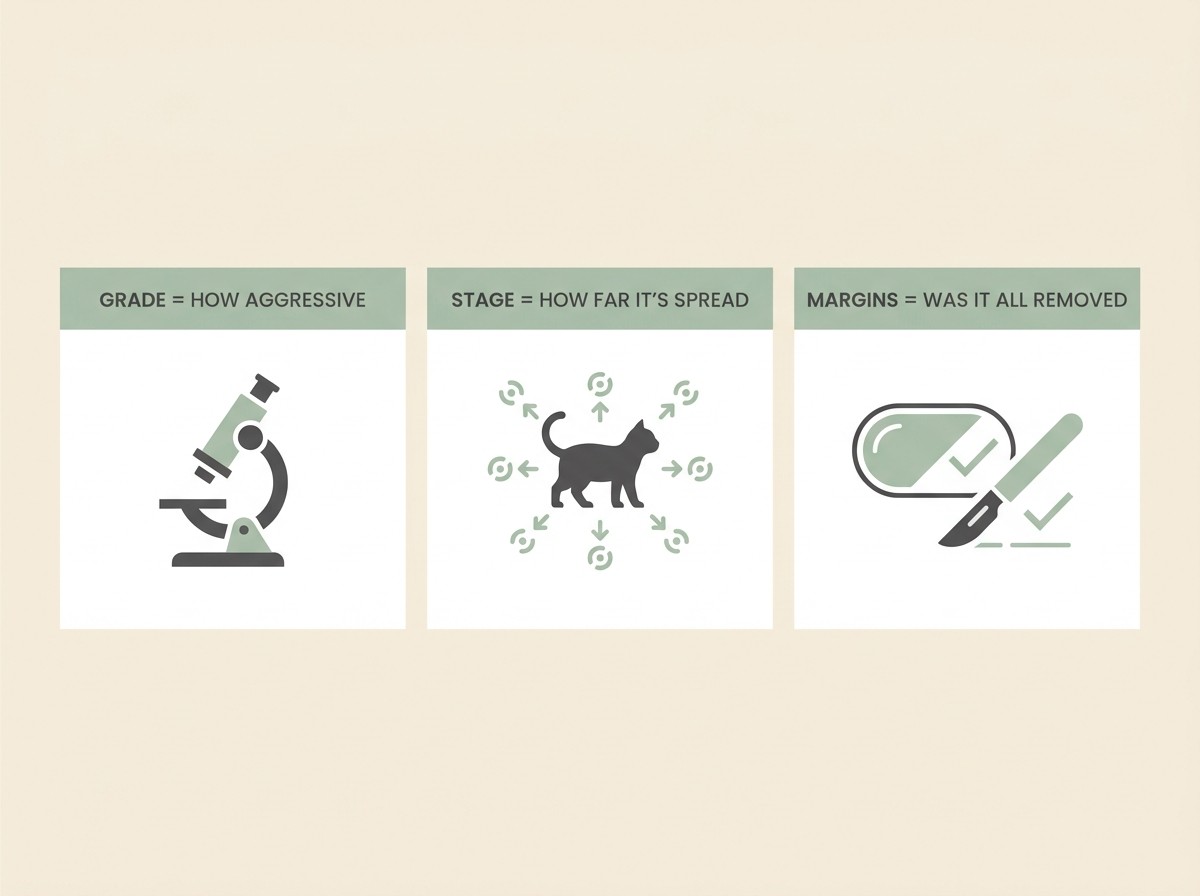
Grade describes how the cancer looks down the microscope, and from that, how aggressively it's likely to behave. A pathologist grading a tumour is weighing things like how fast the cells are dividing (the "mitotic count"), how abnormal and disorganised they look, and how far they've started to invade the tissue around them (Clinician's Brief). The further a tumour's cells have drifted from looking like normal, orderly tissue, the higher the grade tends to be.
A low-grade tumour looks and behaves more like the tissue it grew from. It usually grows slowly and is less likely to spread. A high-grade tumour looks chaotic, grows faster, and carries a higher chance of spreading or returning after it's removed. That's why grade matters so much for the plan. It's one of the main things telling your vet whether an operation on its own might be enough, or whether something like chemotherapy or radiation should be in the conversation too.
Here's a point that catches owners out. Grade comes from a proper tissue sample sent to a pathologist, never from how the lump feels or how big it is. You genuinely cannot grade a cancer by looking at it, and that's exactly why the sample matters. It's also why your vet might use slightly different grading words for the same type of cancer, since the system varies by tumour. Some cancers are graded one, two or three; others simply as low or high grade. The label matters less than what it's telling you, which is how likely this particular tumour is to behave badly.
Stage: how far it's spread
If grade tells you what kind of trouble the cancer is, stage tells you how far that trouble has got. Staging describes where the disease is in the body (Clinician's Brief). Broadly, your vet is asking three things: how big or advanced the original tumour is, whether it's reached the nearby lymph nodes, and whether it's travelled further afield to somewhere like the lungs. That distant spread is called metastasis.
Oncologists often write this down in a shorthand called the TNM system, where T stands for the tumour itself, N for the nodes and M for metastasis (Clinician's Brief). You don't have to decode it. What it captures is simple: a cancer still sitting in one spot is a very different situation from one that has already travelled, even when the lump itself looks identical.
To work the stage out, your vet may suggest some staging tests. Which ones depends on the cancer type, but they often include chest X-rays to check the lungs, an ultrasound of the tummy, blood tests, and a small sample from a nearby lymph node (AAHA, 2026; Clinician's Brief). It can feel like a lot of poking and prodding at an already awful time. The reason it's worth it is that staging changes the plan. There's little sense putting your pet through a big operation if the cancer has already spread, and on the other side of that, learning it hasn't spread can turn a frightening diagnosis into a very treatable one.
Margins: was it all removed?
One more term turns up the moment anything is removed, and it's worth understanding because it decides whether you're finished.
When a lump is taken out and sent to the lab, the pathologist checks the edges of what came away. A clear rim of normal tissue all the way around, with no cancer cells reaching the cut edge, is described as "clean" or complete margins. It means the visible lump and the microscopic disease around it have very likely all been taken (VCA Hospitals). Cancer cells sitting right at the edge means "dirty" or incomplete margins, which suggests some microscopic cancer has probably been left behind (Royal Canin Academy).
Dirty margins aren't a disaster, but they do mean a decision. The usual options are a second, wider operation to remove the scar with a margin of healthy tissue around it, or sometimes radiation to mop up what remains (VCA Hospitals). That's why your vet may sound cautious even after a "successful" removal, and why that lab report matters as much as the surgery did. Our guide to cancer surgery and clean margins goes into what this means in practice.
Putting it together: what a prognosis really is
Type, grade and stage are the three things your vet blends into a prognosis, a realistic estimate of the likely outlook. Hold onto this: a good vet gives you a range, not a date.
You'll often hear a figure like "median survival time". It sounds ominous, so it helps to know what it actually means. The median is the midpoint, so half of pets with that diagnosis live longer than the figure quoted, often well beyond it (Pieper Veterinary). It is not a use-by date stamped on your pet, and there's no predicting where any one animal falls, because the spread either side of that middle number is usually wide (Pieper Veterinary). Our piece on reading a prognosis walks through how to make sense of the numbers without being falsely reassured or needlessly crushed.
Any survival figure also comes with strings attached. It usually assumes a particular treatment choice, so a different decision gives a different number, and it assumes a particular type, grade and stage. That's why a prognosis from a forum thread about someone else's dog tells you almost nothing about yours.
There's a further distinction worth making early, because it changes how the whole thing feels. The figure that really matters is good time, not raw time. Veterinary cancer treatment generally aims at quantity and quality of life together, not just stretching the calendar out (Pieper Veterinary; AAHA, 2026). A good run of comfortable, happy weeks counts for far more than a longer stretch your pet doesn't enjoy. That's a kinder way to hold the months ahead than a countdown, and it's something you can keep an eye on rather than guess at, which is what quality-of-life tracking is for.
What to ask your vet
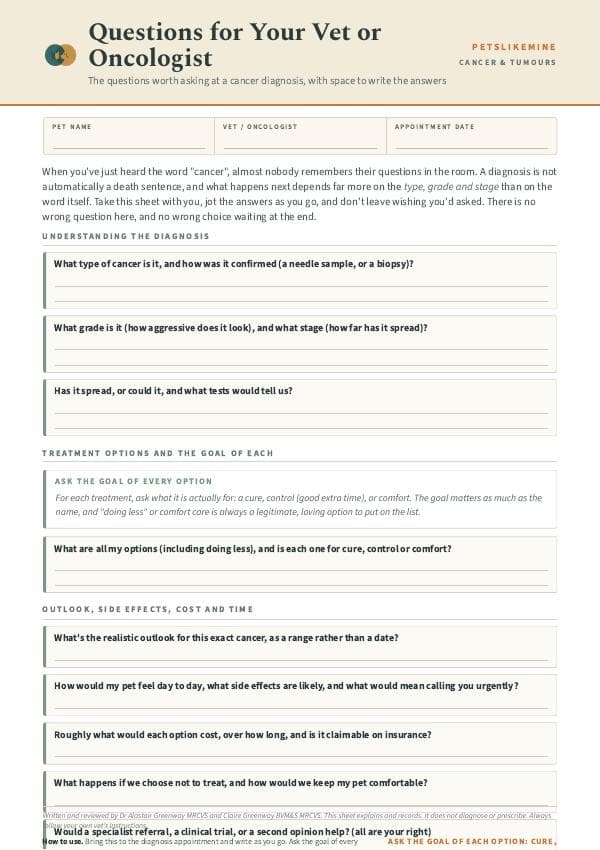
You'll think more clearly when you go back in if you've got a few questions written down. These get you the information that actually counts:
- What type of cancer is it, and how aggressive is it likely to be (the grade)?
- Has it spread, and what tests would tell us (the stage)?
- If it was removed, were the margins clean, and does that mean we're finished?
- What are my realistic options, including the option of comfort-focused care?
- When you give me an outlook, can you give me the range, not just one number?
There's no shame in writing them down or asking to record the conversation. You're being asked to take in a great deal at the worst possible moment.
So carry this much out of today. You don't have to decide everything now, and you almost certainly won't have every answer until the staging is done. Understanding the type, the grade and the stage is the first and most powerful step, because it turns a terrifying word into a specific situation with specific choices. Once you've got that picture, the next pages, on what the realistic outlook is and on whether and how to treat, will mean a great deal more.
References
- Christensen J, Johnson K, Ettinger S, Garrett L, Gordon I, Ireifej S, Love A, Wisecup M. AAHA Oncology Guidelines for Dogs and Cats. Journal of the American Animal Hospital Association. 2026;62(1):1-37. DOI: 10.5326/JAAHA-MS-7549.
- Clinician's Brief. Tumor Grading & Staging in Dogs: A Veterinary Guide.
- Pieper Veterinary. Oncology FAQs.
- VCA Hospitals. Cancer Surgery for Pets (VCA Pet Cancer Alliance).
- Royal Canin Academy. The Role of Surgical Margins and Histology in Tumor Excision.
- Flint Animal Cancer Center, Colorado State University. Treatment Options.
- American Animal Hospital Association (AAHA). How Common Is Cancer in Dogs? Risk and Early Warning Signs. (incidence figures attributed to the Veterinary Cancer Society: approximately 1 in 4 dogs develop cancer in their lifetime, rising to nearly half of dogs over the age of ten)
- American Veterinary Medical Association (AVMA). Cancer in Pets.
Free downloads
Companion worksheets to put what you've read into practice. Free PDFs, print at home.
Sister tool · Sightline
Track quality of life over time
Sightline, a separate ConciergeVet tool, runs a short adaptive weekly assessment with a quality-of-life focus mode built around exactly these frameworks, tracks a single composite score over time so you can see the trend rather than judge a single bad day, and produces a Sightline Report PDF you can bring to your vet.
A written log, or our printable quality-of-life sheet, does much the same job.
See how Sightline tracks quality of lifeFound a lump? Track it, and know when to act
A lump cannot be told apart by look or feel; only your vet sampling it can. The Lump & Bump Tracker records its size and how it changes, flags when it has crossed a line worth a vet visit, and builds a clean history to take in.
Open the Lump & Bump TrackerYou're not doing this alone
Compare treatment journeys and talk to owners managing cancer. Free to join.
Join PetsLikeMine