

Calcium Oxalate Stones: Prevention When You Can't Dissolve Them
Alastair Greenway
BVM&S MRCVS
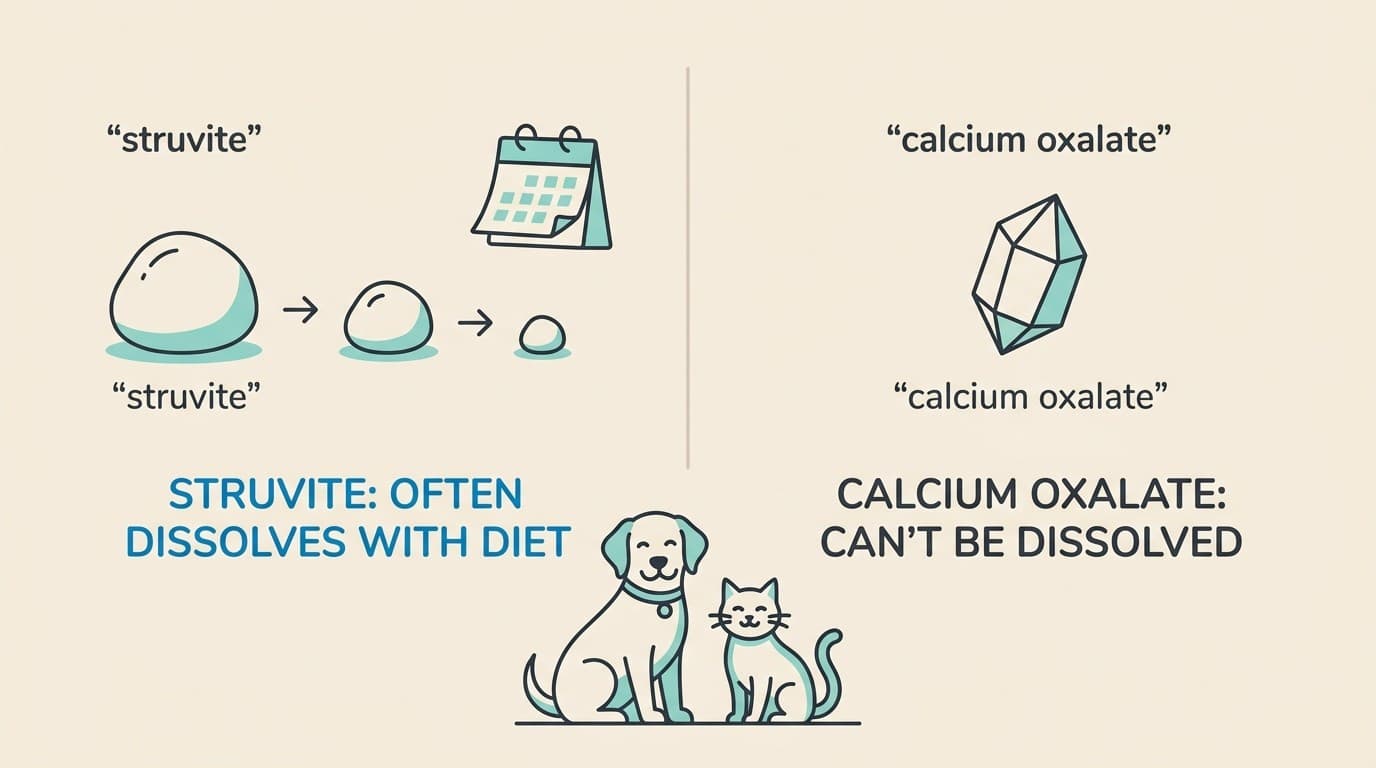
When the lab report names a bladder stone as calcium oxalate, there's a conversation that catches almost everyone off guard: no special diet will melt this one away. Struvite stones can often be dissolved over a few weeks with the right food, so it feels reasonable to assume yours can too. Calcium oxalate doesn't work like that. It can't be dissolved at all, by any diet or medicine, so once it's there it has to be physically removed, and then the whole job becomes stopping the next one forming (ACVIM Small Animal Consensus Recommendations, Lulich et al., 2016).
That's the frustrating part, and it's worth naming. This isn't a stone you fix once and forget. It's a tendency your pet's body has, and your job from here is to keep nudging the odds in their favour for the rest of their life. The good news is that the levers that work are mostly cheap, mostly about water, and entirely within your reach.
Why it can't be dissolved, and what that means for you
A struvite stone forms minerals that a dissolving diet can coax back into solution, a bit like sugar going back into warm water. Calcium oxalate crystals are chemically far more stable, so no diet or drug will break them down inside the bladder (Today's Veterinary Practice, Bartges, 2016). That leaves three options for a stone that's actually causing problems: surgery to open the bladder and lift it out (a cystotomy), flushing very small stones out through the urethra with a catheter technique (voiding urohydropropulsion, only possible when they're tiny), or, for stones causing no trouble at all, sometimes monitoring rather than rushing to operate (VCA Animal Hospitals).
Which route is right is your vet's call, and it depends on the size, the number, where the stones sit and your pet's signs. What matters for this article is everything that comes after removal, because that's where you make the difference.
A quick word of reassurance first. If your pet was straining and you've been told it's stones, the immediate danger is a stone slipping into the urethra and blocking the flow of urine, especially in a male cat or a male dog. A pet straining and passing little or nothing is a genuine emergency, not something to sleep on (see "When a stone causes a blockage" and the Blocked-Cat / Straining-Cat triage tool). Prevention is for the calm period afterwards, once the stone is out and your pet is comfortable.
Step one: check for a reason behind it
Before you reach for diet sheets, your vet may run a blood test to check your pet's calcium level, ideally an ionised calcium rather than just the standard total. Calcium oxalate is largely driven by too much calcium passing into the urine, and in a proportion of cats that traces back to a high blood calcium. About a third of cats with calcium oxalate stones turn out to have a raised blood calcium, usually idiopathic hypercalcaemia (a high calcium with no obvious cause, which is the commonest reason a cat's calcium runs high); in dogs the high calcium is more often the parathyroid gland (Today's Veterinary Practice, Bartges, 2016; Clinician's Brief, calcium oxalate urolithiasis). It's worth checking the ionised level specifically, because a cat can have a normal total calcium and still have a raised ionised calcium that the standard test misses (Clinician's Brief, calcium oxalate urolithiasis).
If there's a treatable cause sitting underneath, finding it changes everything, because managing that is far more powerful than any diet tweak. In most pets no single cause is found, and that's normal too. Either way, the test is worth doing once.
The biggest lever: dilute the urine
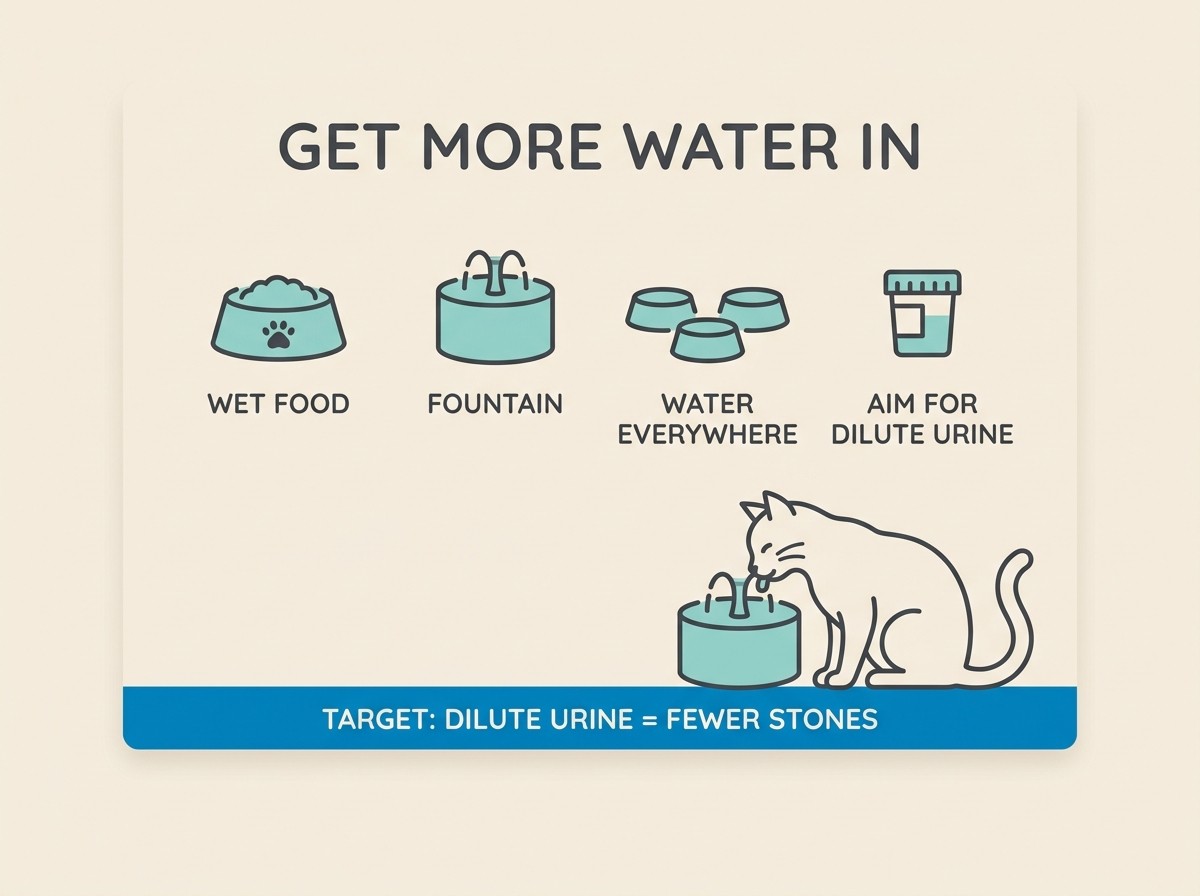
The single most effective thing you can do is keep your pet's urine dilute, because a watery urine simply can't hold as much mineral, so crystals are far less likely to clump into a stone (ACVIM consensus, 2016). Vets put a number on it: aim for a urine specific gravity at or below 1.020 in dogs and below 1.030 in cats (Minnesota Urolith Center). In healthy dogs, dropping the specific gravity from 1.034 to 1.024 cut calcium oxalate saturation by about 34% (Minnesota Urolith Center, citing Stevenson 2003). Your vet checks this from a urine sample, and it's the most useful number to track over time.
The easiest way to get there is wet food. A high-moisture diet (canned food, or dry food with water mixed in) does more for the bladder than almost anything else, which is why it's the first recommendation in the guidelines (ACVIM consensus, 2016). Alongside that, get water everywhere: several stations away from the food bowl, wide bowls that don't tickle a cat's whiskers, a fountain if your cat prefers moving water, and fresh top-ups daily. For the full toolkit, see "Water, diet and your cat's bladder" and the water-intake boosting guide download. This is real medicine, not a throwaway tip, and it pairs with the FIC & Water-Intake tracker so you can actually watch the intake climb.
Get the diet right (and don't overcorrect)
There are prescription diets formulated to prevent calcium oxalate, and a wet version usually beats a dry one. They work by promoting a dilute, neutral urine and by getting the mineral balance right, rather than by dissolving anything (ACVIM consensus, 2016). A few points to hold on to:
- Don't acidify. Diets that push the urine acidic (a pH below 6.5) actually raise the calcium oxalate risk. The target is a neutral to slightly alkaline urine, roughly pH 6.5 to 7.5 (Minnesota Urolith Center). This is part of why feline calcium oxalate has become so much commoner over the decades: as diets were acidified to prevent struvite, the balance tipped the other way, and oxalate rose from under 10% of feline stones in the early 1980s to around 41% by 2013 (Today's Veterinary Practice, Bartges, 2016).
- Be sensible about protein. The evidence here is genuinely mixed: high protein can push the urine acidic and shed more calcium into it, yet some studies in dogs and cats actually found a lower stone risk on higher-protein diets. Nobody has pinned down the ideal amount, so most calcium-oxalate-prevention diets settle on a moderate, balanced protein level rather than a maximum. The takeaway is that a balanced prescription diet is a safer bet than a hugely meat-heavy home-made bowl (Veterian Key, calcium oxalate urolithiasis).
- Skip the wrong supplements. Stop any calcium or vitamin C supplements (vitamin C can be turned into oxalate in the body), and don't add vitamin D without veterinary advice. Go easy on very high-oxalate human foods if your pet shares them: spinach, rhubarb, beetroot and nuts are the usual offenders (VCA Animal Hospitals).
- Don't restrict calcium to extremes on your own. Slashing calcium can backfire and actually increase oxalate absorption, which is why this is a vet-guided diet rather than a DIY one.
The headline is that there's no single "urinary diet" that fits every stone. A struvite-dissolving diet and a calcium-oxalate-prevention diet are different jobs, so the right one depends entirely on what your pet's stone was made of (see "Bladder stones: the two main types").
When diet and water aren't enough: medication
For pets who keep forming stones despite a good water and diet plan, your vet has two main tools. Potassium citrate is given when the urine stays stubbornly acidic; it helps nudge the pH up and binds some of the calcium so it's less available to form crystals (ACVIM consensus, 2016). For frequent recurrers, a thiazide diuretic such as hydrochlorothiazide can be added to reduce the calcium spilling into the urine, though the evidence here is more mixed in cats and it's reserved for genuinely recurrent cases, not used routinely (Minnesota Urolith Center; Today's Veterinary Practice, Bartges, 2016). These are add-ons for the harder cases, layered on top of water and diet rather than instead of them.
Be realistic about recurrence, and keep watching
Calcium oxalate has a real tendency to come back, even when you do everything right, and there's no use pretending otherwise (VCA Animal Hospitals). In cats it's usually a slow story rather than a flood. In one large series of more than 2,000 cats, about 7% had a first recurrence, only 0.6% a second and 0.1% a third (Today's Veterinary Practice, Bartges, 2016). It varies a lot between individual pets, so this is about playing the long game and catching any new stone while it's small.
That's exactly why monitoring matters so much. The plan most vets follow is a urine test and a bladder X-ray (sometimes an ultrasound) at around a month after the stone comes out, then repeated every three to six months for life (VCA Animal Hospitals; the Minnesota centre suggests imaging every six to twelve months). Spotting a tiny new stone on a scan means it can sometimes be flushed out without surgery, long before it ever causes your pet pain or a blockage. Tracking the urine specific gravity at these checks also tells you whether your water plan is actually working.
It helps to know which pets are prone, so you stay alert. On the dog side, the classic small breeds are miniature schnauzers, bichon frises, Lhasa apsos, Shih Tzus and Yorkshire terriers, with middle-aged males overrepresented. In cats, it's more an older-cat problem (often eight to twelve years), and Persians, Himalayans, Burmese and Ragdolls show up more than average (VCA Animal Hospitals; Today's Veterinary Practice, Bartges, 2016).
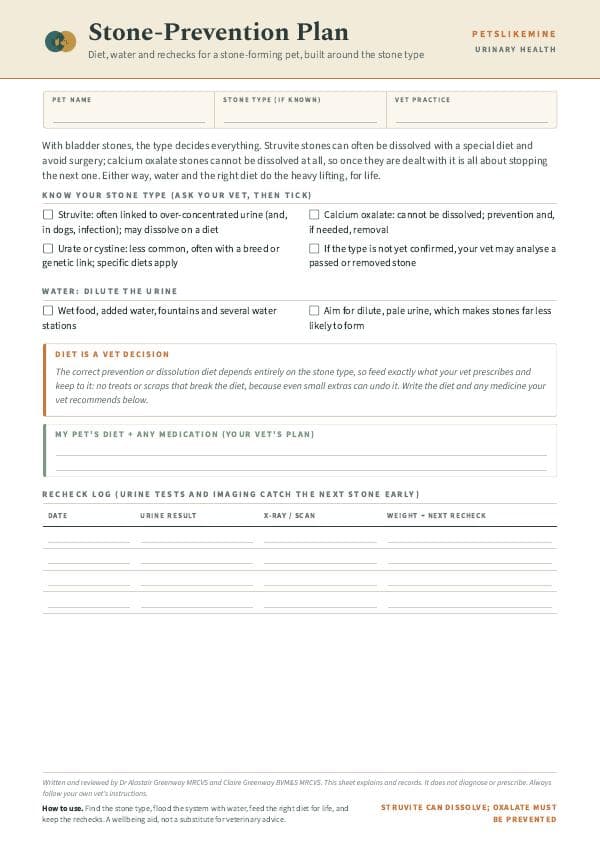
None of this is your fault. Calcium oxalate is a chemistry-and-genetics problem far more than a care problem, and the fact that it can recur isn't a sign you've done anything wrong. What you can do, keeping the urine dilute, getting the diet right and turning up for the recheck scans, genuinely tilts the odds. Log the water intake and any signs on the FIC & Water-Intake tracker, keep the stone-prevention diet and water worksheet on the fridge, and put those recheck dates in the diary now, while you're thinking about it.
References
- Lulich JP, Berent AC, Adams LG, Westropp JL, Bartges JW, Osborne CA. ACVIM Small Animal Consensus Recommendations on the Treatment and Prevention of Uroliths in Dogs and Cats. *Journal of Veterinary Internal Medicine*, 2016. (DOI: 10.1111/jvim.14559)
- Bartges JW. Feline Calcium Oxalate Urolithiasis (and the struvite-to-oxalate epidemiological shift; recurrence figures). *Today's Veterinary Practice* / *Journal of Feline Medicine and Surgery*, 2016. and https://journals.sagepub.com/doi/10.1177/1098612X16660442 (DOI: 10.1177/1098612X16660442)
- Minnesota Urolith Center, University of Minnesota College of Veterinary Medicine. Step by step: Risk management for calcium oxalate (CaOx). Target urine specific gravity (below 1.020 dogs, below 1.030 cats), pH 6.5 to 7.5, water intake and canned food, potassium citrate, hydrochlorothiazide for highly recurrent stones, imaging every 6 to 12 months; quotes the 34% drop in CaOx saturation from a urine specific gravity of 1.034 to 1.024 (Stevenson 2003).
- Stevenson AE, Hynds WK, Markwell PJ. Effect of dietary moisture and sodium content on urine composition and calcium oxalate relative supersaturation in healthy miniature schnauzers and labrador retrievers. *Research in Veterinary Science*, 2003 (the source of the 1.034-to-1.024 / 34% figure).
- VCA Animal Hospitals. Calcium Oxalate Bladder Stones in Dogs. Owner-facing prevention, recurrence, monitoring schedule (X-ray and urinalysis at one month then every three to six months for life), predisposed breeds, urohydropropulsion, avoiding calcium/vitamin C/vitamin D supplements and high-oxalate foods.
- Clinician's Brief. Calcium Oxalate Urolithiasis / Calcium Oxalate Crystalluria in Dogs & Cats. Hypercalcaemia, idiopathic hypercalcaemia and the case for measuring ionised calcium. and https://www.cliniciansbrief.com/article/calcium-oxalate-crystalluria
- Veterian Key (urology reference chapter). Calcium Oxalate Urolithiasis. The mixed evidence on dietary protein, avoiding acidifying diets, target urine pH around 7.0, and increasing water intake as the most important modification.
- Bijsmans ES, Quéau Y, Biourge V. Increasing Dietary Potassium Chloride Promotes Urine Dilution and Decreases Calcium Oxalate Relative Supersaturation in Healthy Dogs and Cats. *Animals (Basel)*, 2021 (supporting the dilution principle).
Free downloads
Companion worksheets to put what you've read into practice. Free PDFs, print at home.
Keep track of how your pet is doing
The owners who cope best are the ones who notice changes early. A simple health log shows you what is working, and what is not, before the next vet visit.
Start tracking, freeYou're not doing this alone
Compare treatment journeys and talk to owners managing urinary health. Free to join.
Join PetsLikeMine