


Blood in Your Pet's Urine: What It Means and How Worried to Be
Alastair Greenway
BVM&S MRCVS
A pink puddle on the floor, a red-tinged clump in the litter tray, a drip that's clearly not the right colour: any of these makes your stomach drop. The word "blood" does a lot of frightening work in your head, so let's take the fear down a notch. On its own, blood in the urine is usually a sign of irritation in the bladder, not a catastrophe, and most of the causes are treatable. There's one important exception, and we'll deal with it first, because it's the only part of this page that can't wait.
First, the one thing that can't wait
If your pet is a male cat, and he's straining in the tray, going in and out over and over, crying, and passing little or no urine, possibly with just a few blood-tinged drops, treat this as a life-threatening emergency and ring your vet or the out-of-hours service now, tonight.
This can be a urethral obstruction, a blockage of the narrow tube that carries urine out. Male cats have a long, narrow urethra, which is why a block happens almost exclusively in them (2025 iCatCare consensus guidelines; Cornell Feline Health Center). When urine can't get out, the bladder backs up, waste and potassium build up in the blood, and a fully blocked cat can die within roughly 24 to 48 hours (Cornell Feline Health Center). It is not constipation and not a simple urine infection. The few drops of blood are a red herring here, the straining-with-nothing is the emergency. (See: Is this an emergency? The blocked-cat signs you must not wait on, and the Blocked-Cat triage tool.)
If that's not your situation, a pet that is clearly passing urine, even with blood in it, has some time. Read on.
Why there's blood there in the first place
Blood in the urine has a name, haematuria, and it simply means red blood cells are getting into the urine somewhere between the kidneys and the outside. The colour can range from a barely-there pink tinge to obvious red, and, reassuringly, the amount of colour doesn't track the seriousness well. A tiny amount goes a long way to colouring urine, so a dramatic-looking puddle can come from a very ordinary, treatable cause.
In both species the commonest reason is inflammation of the bladder lining, which is fragile and bleeds easily when irritated. What's irritating it is the real question, and the answer differs in cats and dogs.
Cats: usually cystitis, and usually not an infection
This is the single most important thing for a cat owner to understand, because it's the thing the internet gets most wrong. In cats, by far the commonest cause of blood and straining is feline idiopathic cystitis (FIC), a sterile, stress-linked inflammation of the bladder. It accounts for roughly 55 to 65% of cats seen for lower urinary signs (2025 iCatCare consensus guidelines). It looks exactly like a urine infection, blood, frequent small wees, straining, weeing outside the tray, but there's no bacteria to kill.
A genuine bacterial urine infection is actually uncommon in otherwise-healthy adult cats, quoted at under 3% of these cases (2025 iCatCare consensus guidelines). That's why antibiotics so often "don't work" for a straining cat, there was nothing for them to treat. The real treatment for FIC is pain relief in a flare, more water, and reducing your cat's stress. (See: Feline idiopathic cystitis: why stress gives your cat a sore bladder, and "Is it a UTI?" Why your cat probably hasn't got one.)
The other common cat cause is bladder stones or crystals, which scratch and irritate the lining; uroliths account for somewhere around 10 to 23% of feline lower urinary cases (2025 iCatCare consensus guidelines). And the dangerous one, again, is a developing urethral block, which is why the male-cat rule above matters so much.
There's an age twist worth knowing. The picture flips in older cats. Cats over about 10, and cats with kidney disease, diabetes or an overactive thyroid, genuinely do get more bacterial infections, with positive urine cultures reported in around 12 to 22% of cats with those conditions (Mayer-Roenne et al., J Feline Med Surg 2007). So in a senior cat, a real infection moves up the list, which is one reason your vet may want a urine sample to check.
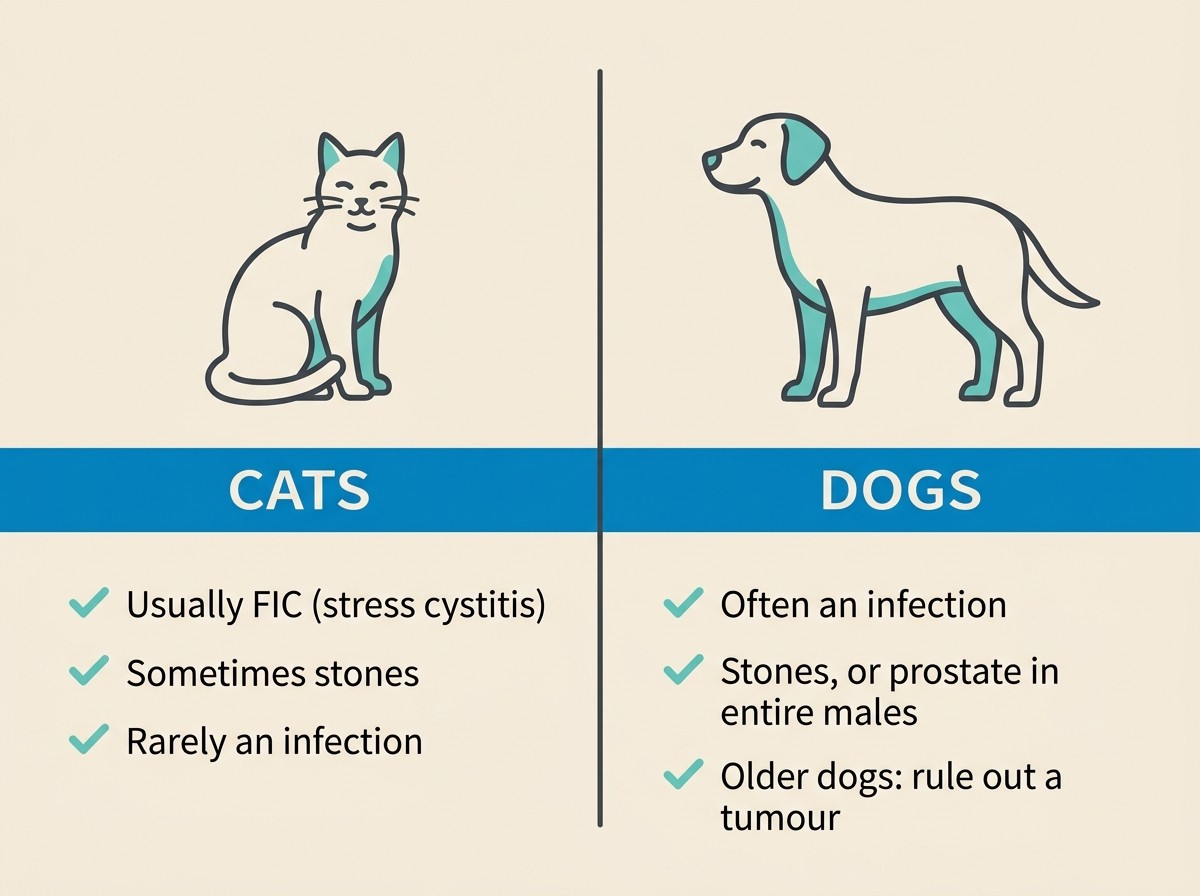
Dogs: infection is genuinely common, but it's not the only thing
Dogs are different. A true bacterial urinary tract infection really is common in dogs, especially in female dogs, so when a dog has blood in the urine, an infection is a reasonable first thought. In one study of 162 dogs with visible blood in the urine, the leading causes were urinary infection (about 29%), bladder stones (about 26%), prostate problems in entire males (about 17%) and urinary tumours (about 9%) (Adamama-Moraitou et al., N Z Vet J 2017).
A few of those deserve a flag:
- Stones are common in dogs and, as in cats, whether they can be dissolved or have to be removed depends entirely on the stone type. (See: Bladder stones in cats and dogs: the two main types.)
- Prostate disease in an unneutered male dog can cause blood in the urine or blood dripping separately from urination, and it's worth a proper check.
- Bladder tumours are uncommon but real, and they become more likely in older dogs. The commonest is transitional cell carcinoma (also called urothelial carcinoma), the most frequent urinary bladder cancer in dogs (Fulkerson & Knapp, Vet J 2015), which tends to affect older dogs, with a reported mean age at diagnosis of around 11 years. The clue is signs that don't clear up: a "UTI" that keeps coming back, or blood and straining that persist despite a course of antibiotics, deserves imaging rather than another round of pills.
One non-urinary source to keep in mind: an unspayed bitch in season is bleeding from the vulva, not the bladder, which can look like bloody urine but isn't. If she's intact and due to be in heat, that's worth considering before you panic.
"Is it definitely blood?"
Occasionally what looks like blood isn't. Genuinely red urine can also come from pigments rather than red blood cells, free haemoglobin released when red cells break down, or myoglobin released from damaged muscle, both of which can turn urine red to brown without it being bleeding from the bladder at all (Clinician's Brief, urinalysis interpretation). These point to quite different, sometimes serious, problems elsewhere in the body. There's a simple lab clue your vet uses: spin the sample down, and true blood settles to leave clearer liquid on top, while pigment stays evenly red. You don't need to work this out at home, but it's a useful reason not to assume the cause from the colour alone, and to let the vet test rather than guess.
So, how worried should you be?
Here's how we'd weigh it, the same way we would in the consulting room.
- Go now (tonight): a male cat straining and passing little or nothing, with or without blood. That's a suspected block. Don't wait. (Use the Blocked-Cat triage tool if you're unsure.)
- Same day: any pet that's clearly distressed, in pain, off food, lethargic, vomiting, or unable to settle; or a lot of fresh blood; or a male dog straining to pass urine.
- A prompt appointment (the next day or two): a comfortable pet who is eating, drinking and passing urine normally apart from a pink tinge or occasional spot of blood. This is the commonest scenario, and it's usually cystitis or a treatable infection or stones. It needs seeing, but it isn't a midnight dash.
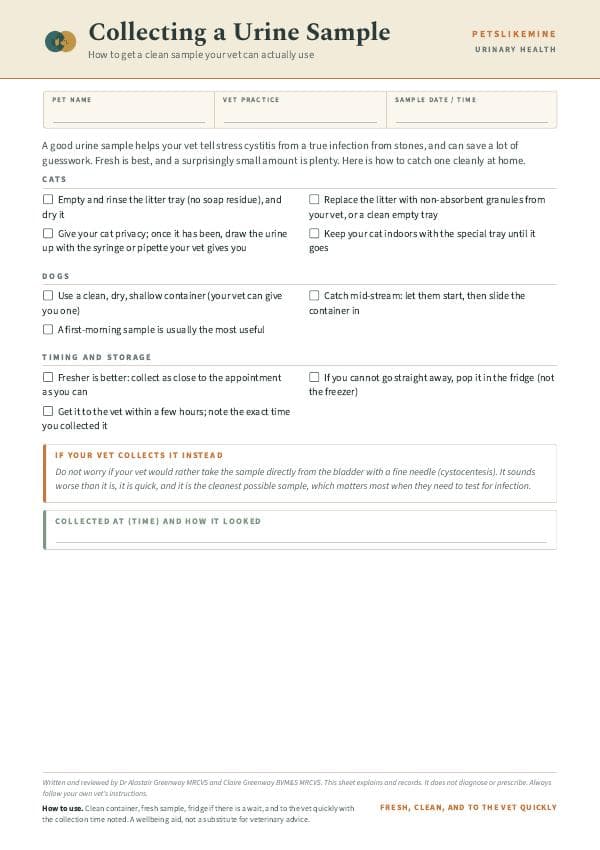
Whatever the urgency, blood in the urine always earns a vet visit, because the only way to tell cystitis from stones from an infection from something rarer is to look. Your vet will examine your pet, almost always test a urine sample (for blood, crystals and infection) and sometimes scan or x-ray for stones (Cornell Feline Health Center). It genuinely helps to bring a fresh urine sample if you can catch one. (See: How to describe urinary signs to your vet, and how to collect a urine sample, and the urine sample collection how-to download.)
While you wait for the appointment
For a comfortable pet waiting for a routine appointment, the most useful thing you can do is get more water in, dilute urine is less irritating to an inflamed bladder and less likely to form crystals (see: Why getting more water in is the best thing you can do for your pet's bladder, and the FIC & Water tracker). For a cat, keeping things calm and the litter trays clean and plentiful won't hurt either. A few things to steer clear of: don't give human painkillers (many are toxic to cats and dogs), don't reach for cranberry products (they're aimed at a bacterial problem your cat probably hasn't got), and, the rule worth tattooing on your hand, don't wait it out in a male cat who isn't producing urine.
Blood in the urine is alarming to see and almost always treatable once you know the cause. Catch a sample, book the visit, and, if it's a straining male cat passing nothing, make that call right now.
References
- Taylor S, Boysen S, Buffington T, et al. 2025 iCatCare consensus guidelines on the diagnosis and management of lower urinary tract diseases in cats. *Journal of Feline Medicine and Surgery*. 2025. (PMC: https://pmc.ncbi.nlm.nih.gov/articles/PMC11816079/)
- Cornell Feline Health Center. Feline Lower Urinary Tract Disease. Cornell University College of Veterinary Medicine.
- George CM, Grauer GF. Feline Urethral Obstruction: Diagnosis and Management. *Today's Veterinary Practice*.
- Adamama-Moraitou KK, Pardali D, Prassinos NN, Menexes G, Patsikas MN, Rallis TS. Evaluation of dogs with macroscopic haematuria: a retrospective study of 162 cases (2003-2010). *New Zealand Veterinary Journal*. 2017;65(4):204-208.
- Mayer-Roenne B, Goldstein RE, Erb HN. Urinary tract infections in cats with hyperthyroidism, diabetes mellitus and chronic kidney disease. *Journal of Feline Medicine and Surgery*. 2007.
- Clinician's Brief. Urinalysis Interpretation in Canine & Feline Patients (pigmenturia vs true haematuria; centrifugation test).
- Fulkerson CM, Knapp DW. Management of transitional cell carcinoma of the urinary bladder in dogs: a review. *The Veterinary Journal*. 2015;205(2):217-225.
- Griffin MA, Culp WTN, Rebhun RB. Lower urinary tract neoplasia (mean age at TCC diagnosis ~11 years). *Veterinary Sciences*. 2018;5(4):96.
Free downloads
Companion worksheets to put what you've read into practice. Free PDFs, print at home.
Keep track of how your pet is doing
The owners who cope best are the ones who notice changes early. A simple health log shows you what is working, and what is not, before the next vet visit.
Start tracking, freeYou're not doing this alone
Compare treatment journeys and talk to owners managing urinary health. Free to join.
Join PetsLikeMine