


What Happens at the Vet: Unblocking, the Catheter and the Hospital Stay
Alastair Greenway
BVM&S MRCVS
The call is made, or about to be, and your blocked cat is going in. That's the hardest and most important step done, because a male cat who can't pass urine is in a true emergency, not constipation and not a simple infection, and getting him seen today is what saves him (there's the full picture in [the blocked cat: the emergency every owner of a male cat must recognise]). What comes next can sound like a frightening blur of words: catheter, drip, potassium, a few nights in hospital, a bill you weren't expecting. This page walks you through it calmly, so the hospital stay feels like a plan rather than a void.
First, making your cat safe
When you arrive and say "I think my cat is blocked", the team move fast, and not all of it is about the blockage itself. A fully blocked bladder backs urine up to the kidneys and lets potassium climb in the blood, and a high enough potassium level disturbs the heart's rhythm, which is the part that can kill (2025 iCatCare consensus guidelines). So the first job is often not the catheter at all. It's a quick blood test to check the potassium and the kidney values, a drip into the vein to start flushing those toxins out and support the circulation, and, if the potassium is dangerously high, specific medicines to protect the heart while everything else catches up.
In a cat who is very unwell, the vet may first relieve the pressure by drawing some urine off the bladder through the belly wall with a fine needle, a step called decompressive cystocentesis. It buys time, eases the pain, and can make passing the catheter easier; studies find it carries a low risk of complications, though vets weigh it case by case (Today's Veterinary Practice).
Unblocking: the catheter and the flush
The word "catheter" makes this sound worse than it is. Your cat will be sedated or given a general anaesthetic first, so he is asleep or deeply relaxed and feels none of it. In UK general practice this is the norm: in a large study of blocked cats, a general anaesthetic was used in around 46% of cases and sedation in a further 43% (Beeston et al., 2022).
With your cat settled, the vet passes a thin, soft tube (the urinary catheter) up the urethra to where it's plugged, then gently flushes sterile fluid against the blockage to wash the gritty plug of crystals, mucus and debris back into the bladder. The bladder is then flushed through several times to rinse out the sludge that caused the problem, and the moment urine flows freely again the immediate danger to the heart and kidneys starts to lift. This catheter is used in the great majority of cases, around 92% in that UK study, so it's very much the standard way back from a block (Beeston et al., 2022).
In most cats a soft catheter is then left in place and stitched lightly so it can't slip out. It does two things: it keeps the urethra open while the swelling and spasm settle, and it lets the team measure exactly how much urine your cat is producing, which matters a great deal over the next day or two.
Why it's a few nights, not a few hours
This is the question owners ask most, and the answer is that the dangerous part isn't only the blockage. It's what the body does once the dam is opened.
After a blockage is relieved, many cats pour out a huge volume of urine for a day or so, far more than normal, as the kidneys dump the backed-up waste and salts. Around 46% of unblocked cats go through this "post-obstructive diuresis" in the first six hours (Cooper, Today's Veterinary Practice; Fröhlich et al., 2016). If the drip doesn't keep pace, a cat can swing from too-full to dangerously dehydrated. So the team run what's called an "ins and outs" plan: they measure the urine leaving through the catheter and match it with fluid going in, alongside repeat blood tests to watch the potassium and kidney values come back to normal. That balancing act is the real work of the hospital stay, and it's why your cat needs to be there rather than home with you.
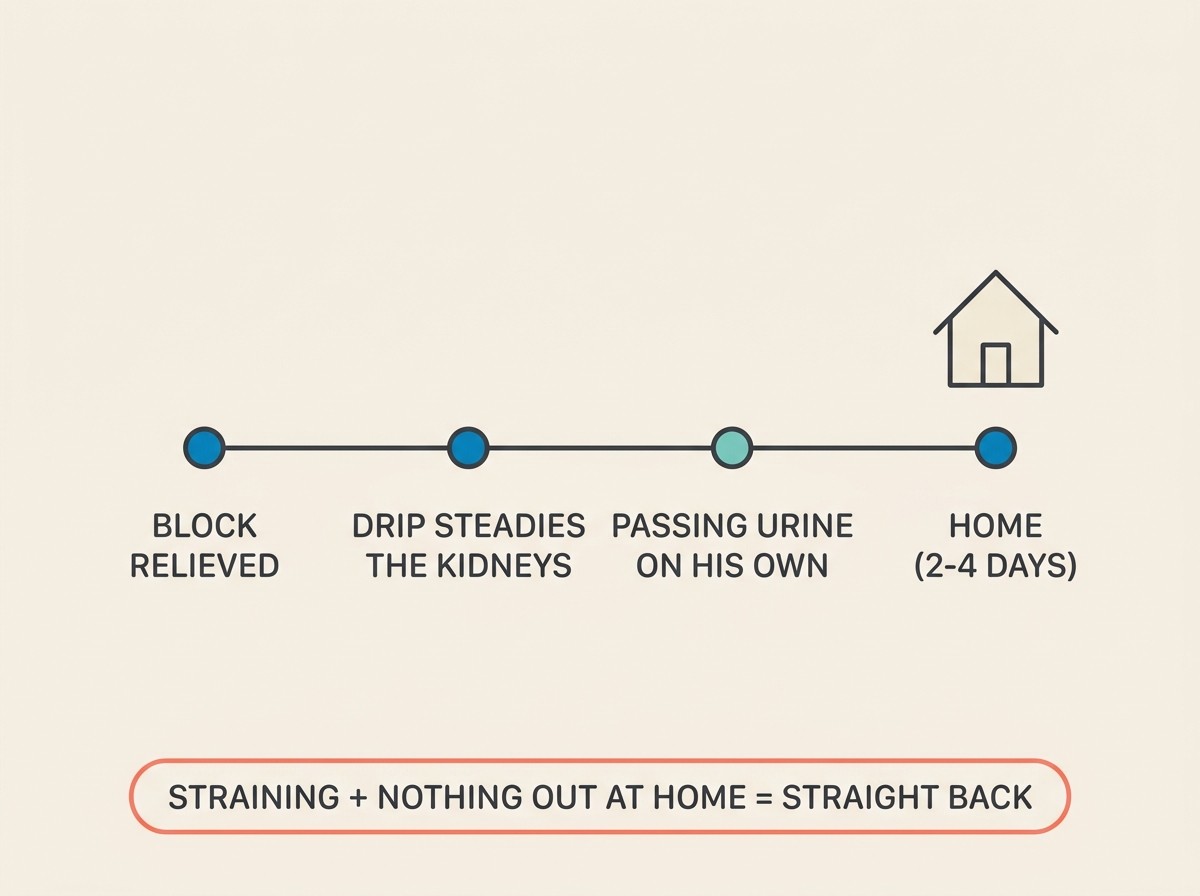
How long does it take? The catheter usually stays in for around a day to two days, often pulled once the urine runs clear and the bloodwork has settled, and most cats are in hospital for roughly two to four days in total, depending on how ill they were on arrival (2025 iCatCare consensus guidelines; Cooper, Today's Veterinary Practice). A cat who arrived early and brightly may need only a short stay; one who came in collapsed and very poisoned needs longer. Throughout, your cat has pain relief on board, because a blocked bladder genuinely hurts, and often a medicine to relax the urethral muscle and ease the spasm. Your vet will keep you updated, and a visit or phone update each day is usually possible.
Coming home, and the careful first days
The catheter comes out once your cat is reliably passing urine on his own, eating, and his bloods are back to normal. That's the green light for home.
Expect him to visit the tray more often than usual for a few days, and to look a little sore or unsettled, which is normal after the irritation of the block and the catheter. He'll usually come home on pain relief such as buprenorphine (sometimes with gabapentin), often a few days of a urethra-relaxing medicine like prazosin to settle the muscle spasm, and sometimes a special diet, with a clear schedule from your vet (DoveLewis VetWrap). One straight note on prazosin: it can help ease the spasm in those first sore days, but the studies that have tested whether it actually stops cats blocking again haven't found a clear benefit, so think of it as comfort and support, not a guarantee against a re-block (Hanson et al., 2021). Give every medicine exactly as written, and don't stop early just because he seems better.
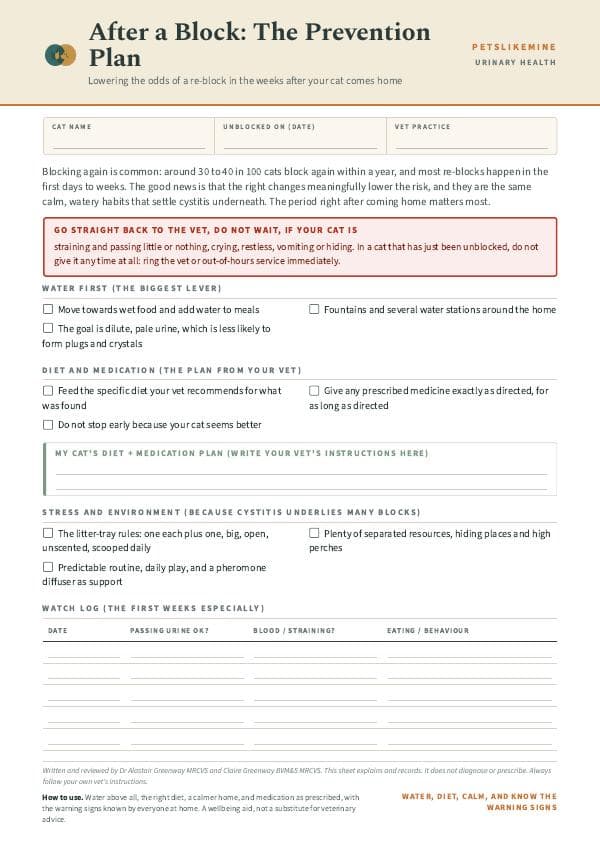
The one thing you must hold onto is the warning sign, because the riskiest window for blocking again is the first days to weeks after coming home. If your cat starts straining and passing little or nothing once more, crying, restless, vomiting or hiding, do not wait and do not give it a night, go straight back to the vet or the out-of-hours service ([the blocked-cat emergency signs are here]). A cat who has just been unblocked has no margin to spare. It helps to keep the [blocked-cat red-flags fridge card] download somewhere everyone can see, with your clinic and emergency numbers already filled in.
The straight talk: cost and outlook
Two things owners deserve straight answers on, because being blindsided makes a frightening night worse.
The cost. Treating a block is intensive care, and it isn't cheap. As a rough, practical UK guide rather than a quote, the whole episode (the unblocking, the anaesthetic, the days on a drip and the repeat blood tests) typically lands somewhere around £1,000 to £3,500, and it can be more at an out-of-hours or referral hospital or if your cat was very ill and stayed longer. Your own vet can give you a proper estimate up front, so ask. And if money is a worry, say so early and openly. Your vet would far rather talk through what's affordable, a payment plan or your insurance than have you delay the visit that saves your cat.
The outlook. This is the reassuring part. Urethral obstruction is a treatable emergency, and for cats who reach the vet in time, more than nine in ten survive the episode and go home (Cooper, Today's Veterinary Practice). Getting there promptly is the single biggest thing in your control, and you've done it.
The longer view is worth a word too. In the large UK study, around two-thirds of blocked cats were still alive some time later, and where cats were put to sleep it was often around a repeat block, when the prospect of more emergencies or the cost made carrying on feel impossible (Beeston et al., 2022). That's really the argument for the next step, not against it: blocking again is common, with somewhere around 30 to 40% of cats getting further urinary signs within a year and the re-blocks tending to come in the first few weeks, and it's partly preventable (Kaul et al., 2020). The discharge plan, water above all, the right diet and a calmer home, genuinely lowers the odds, and there's a do-able version of it in [will it happen again? preventing a re-block after your cat comes home]. For cats who keep blocking despite all that, a surgery called perineal urethrostomy widens the exit and largely removes the risk; it's a reasonable next move, not a failure, and it's covered in [PU surgery (perineal urethrostomy): when it's the right call, and life after].
For now, the hard part is behind you. Your cat is safe, the team have a plan, and the days ahead are about steadying him and then keeping him that way. Once he's home, logging his tray visits, water and any flares on the [FIC & Water tracker] gives you and your vet an early-warning system and something concrete to watch settle back to normal.
References
- Taylor S, Boysen S, Buffington T, Chalhoub S, Defauw P, Delgado MM, Gunn-Moore D, Korman R, et al. *2025 iCatCare consensus guidelines on the diagnosis and management of lower urinary tract diseases in cats.* Journal of Feline Medicine and Surgery, 2025;27(2). doi:10.1177/1098612X241309176. (Urethral obstruction relieved by sedation/anaesthesia and urinary catheterisation; indwelling catheter usually no longer than ~24–36 hours unless azotaemic; decompressive cystocentesis as an option in unstable cats with low complication risk; discharge once urinating, with azotaemia and dehydration resolved; hyperkalaemia and post-renal azotaemia as the life-threatening features.)
- Cooper ES. *Feline Urethral Obstruction: Diagnosis and Management.* Today's Veterinary Practice. (Sedation/anaesthesia and retrograde urohydropropulsion to relieve the obstruction; average indwelling catheterisation ~48 hours; post-obstructive diuresis in 46% (13/28) of cats within 6 hours, "ins and outs" fluid protocol; survival to discharge higher than 90%; recurrence range 11–43%; decompressive cystocentesis benefits and low rupture risk.)
- Beeston D, Humm K, Church DB, Brodbelt D, O'Neill DG. *Occurrence and clinical management of urethral obstruction in male cats under primary veterinary care in the United Kingdom in 2016.* Journal of Veterinary Internal Medicine, 2022;36(2):599–608. doi:10.1111/jvim.16389. (RVC VetCompass UK primary-care cohort: urethral catheter used in 867/938 (92.4%) deobstruction attempts; general anaesthesia 45.8%, sedation 43.4%; decompressive cystocentesis before deobstruction in 127/938 (13.5%); overall survival to May 2020 data collection 67.5% (748/1108); death during a UO episode 329/1108 (29.6%), 88.0% involving euthanasia and 74.7% within 48 hours; repeat catheterisation rate 253/854 (29.6%).)
- Fröhlich L, Hartmann K, Sautter-Louis C, Dorsch R. *Postobstructive diuresis in cats with naturally occurring lower urinary tract obstruction: incidence, severity and association with laboratory parameters on admission.* Journal of Feline Medicine and Surgery, 2016;18(10):809–817. doi:10.1177/1098612X15594842. (Post-obstructive diuresis incidence and severity after relief of obstruction; association with acidaemia and degree of clinical compromise on admission.)
- Waters-Miller J (CVT) / DoveLewis VetWrap. *Blocked: Urethral Obstructions in the Male Cat.* (Discharge medications continued at home including buprenorphine for analgesia, gabapentin, and prazosin as a urethral smooth-muscle relaxant; catheter removed based on urine output, blood values, comfort and urine clarity, once the cat is urinating independently; monitoring for re-obstruction in the days after catheter removal.)
- International Cat Care. *Urethral obstruction in cats* (owner information; without treatment a block can cause kidney failure and be fatal within two to three days; relief by catheterisation under sedation/anaesthesia followed by intravenous fluids and hospitalisation).
- Kaul E, Hartmann K, Reese S, Dorsch R. *Recurrence rate and long-term course of cats with feline lower urinary tract disease.* Journal of Feline Medicine and Surgery, 2020;22(6):544–556. doi:10.1177/1098612X19862887. (Recurrence of lower urinary signs: 43.0% within the first year, 58.1% over a median 38-month follow-up; most recurrent episodes occurred within the first year. Used here for the "roughly 30 to 40% within a year" framing.)
- Hanson KR, Rudloff E, Yuan L, Mochel JP, Linklater AKJ. *Effect of prazosin on feline recurrent urethral obstruction.* Journal of Feline Medicine and Surgery, 2021;23(12):1176–1182. doi:10.1177/1098612X211001283. (Double-blind, placebo-controlled trial: prazosin did not significantly reduce recurrent urethral obstruction versus placebo in the month after relief; supports framing prazosin as comfort/spasm relief rather than a proven re-block preventer.)
Free downloads
Companion worksheets to put what you've read into practice. Free PDFs, print at home.
Keep track of how your pet is doing
The owners who cope best are the ones who notice changes early. A simple health log shows you what is working, and what is not, before the next vet visit.
Start tracking, freeYou're not doing this alone
Compare treatment journeys and talk to owners managing urinary health. Free to join.
Join PetsLikeMine