

The Blocked Cat: The Emergency Every Owner of a Male Cat Must Recognise
Alastair Greenway
BVM&S MRCVS
Of all the things that can go wrong with a male cat, one is worth keeping in your head ready, because it's the urinary emergency that actually kills, and it kills fast. The reason it's so dangerous is how easily it's missed. The signs look so much like constipation, or like the "urine infection" everyone's heard of, that owners wait until morning. By morning it can be too late.
So let's be clear from the top, then take it apart calmly. A male cat who is straining in the litter tray and passing little or nothing is a life-threatening emergency. It can be a urethral obstruction, a true blockage of the tube that carries urine out of the body, and an untreated, fully blocked cat can die within about a day. If that's where you are right now, ring your vet or the emergency service straight away, tonight if it's night, and read the rest once your cat is safe.
What a block actually is
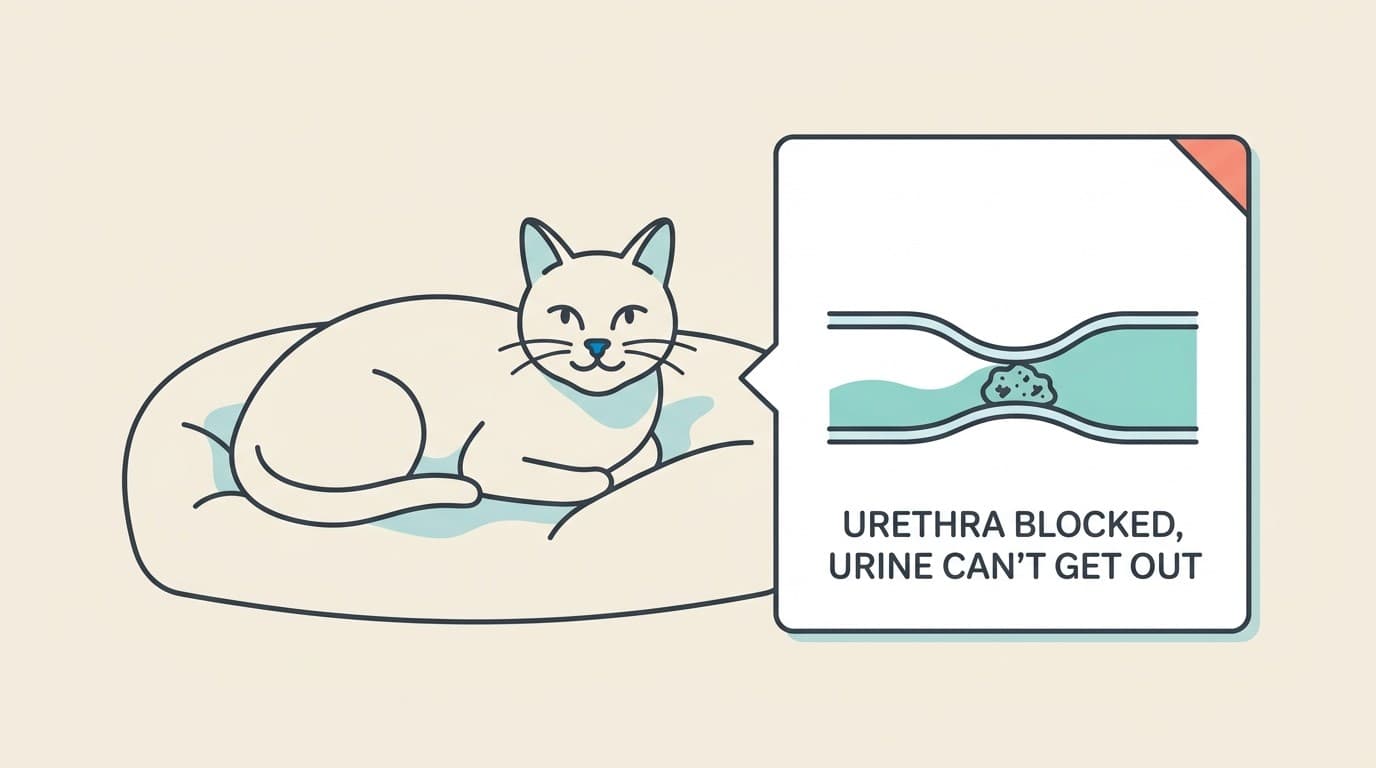
Your cat's urethra is the narrow tube that runs from the bladder to the outside. In a blocked cat, something plugs that tube so urine can't get out. The bladder keeps making urine, the cat keeps trying to pass it, and nothing comes, or only a few drops.
Three things cause the plug, and they often overlap. The commonest is a soft, gritty plug, a mixture of protein, inflammatory cells and crystals that forms in an inflamed bladder and lodges in the urethra. Next is a small stone (a urolith) that travels down and jams. Last is spasm and swelling of the urethra itself, so the tube clamps shut even without a solid blockage. The 2025 iCatCare consensus guidelines describe exactly these three mechanisms, and they're clear that feline idiopathic cystitis (FIC), the stress-linked, sterile bladder inflammation, is the most commonly reported cause sitting underneath a block (iCatCare / Journal of Feline Medicine and Surgery, 2025). That matters for prevention, and we'll come back to it.
Why it's almost always a male cat
A urethral obstruction occurs almost exclusively in male cats (iCatCare, 2025). The reason is plumbing. A female cat's urethra is short and stays a fairly even width all the way out. A male cat's is longer, and it narrows right down towards the tip of the penis, to under a millimetre at its narrowest point compared with a couple of millimetres higher up (Embrace Pet Insurance). That narrow stretch is a natural trap. A plug or a bit of grit that would pass straight through a female cat gets stuck in a male, and the tube spasms around it.
That's why "my cat is straining and nothing's coming out" should set off alarm bells specifically in a tom or a neutered male. Females strain too, but they very rarely block. The cats most often affected are males between about two and ten years old (Clinician's Brief).
Why it's life-threatening, and why hours matter
Here is the part owners most need to understand, because it's what turns a frightening night into a fatal one.
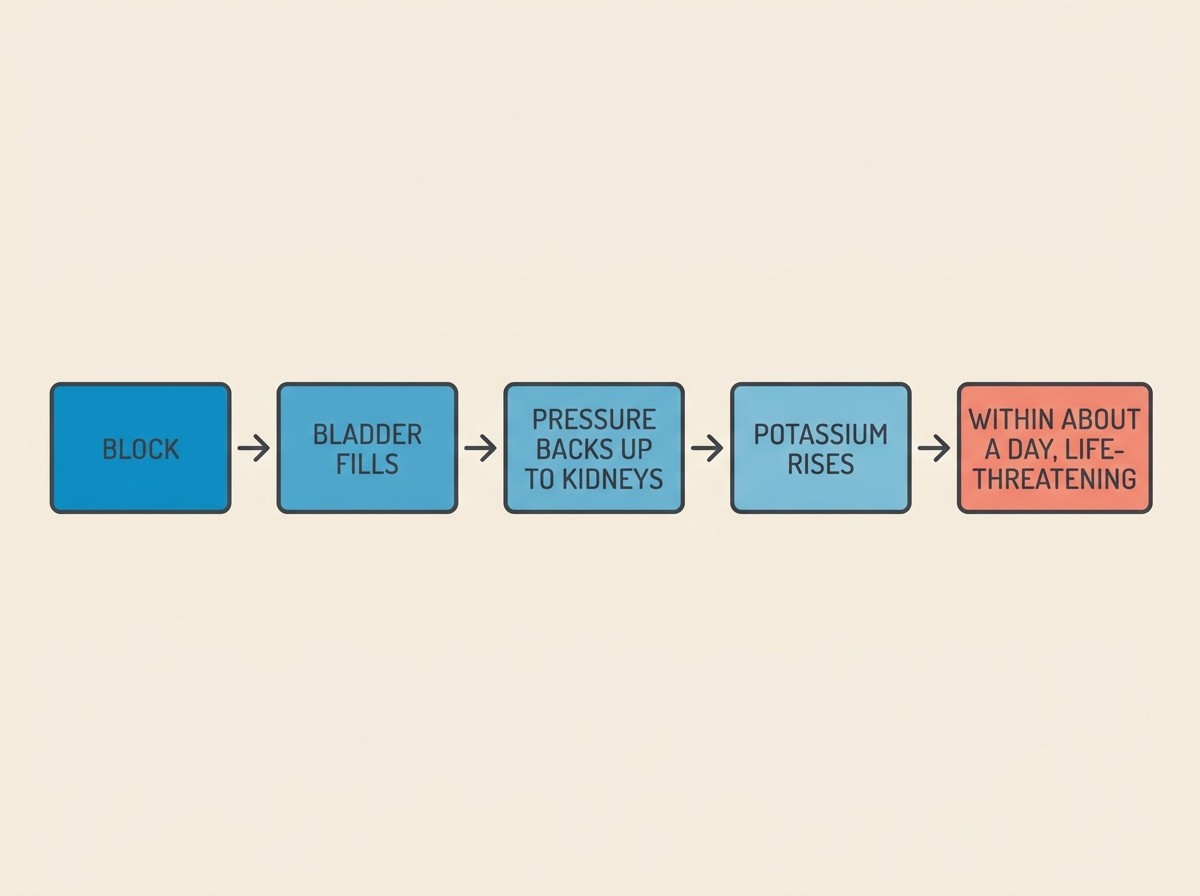
When urine can't get out, the bladder fills and the pressure backs up the system towards the kidneys. The kidneys stop being able to clear waste, so urea and other toxins build up in the blood (your vet will call this post-renal azotaemia). The most dangerous thing that rises, though, is potassium. As potassium climbs, it interferes with the electrical rhythm of the heart, slowing it and throwing it into dangerous rhythms, and at high enough levels it can stop the heart altogether. Hyperkalaemia, that high blood potassium, is the most common life-threatening complication of a block (iCatCare, 2025). On an ECG you can watch it progress, from peaked waves, to the loss of normal beats, towards cardiac arrest (Clinician's Brief).
The timeline is the headline. When a blockage is complete, the dangerous build-up of toxins develops within about 24 to 48 hours (iCatCare, 2025). That's why this is measured in hours, not days, and why "we'll go first thing tomorrow" is a gamble with a cat's life. A cat who looked uncomfortable in the evening can be collapsed and critically ill by morning.
Spotting it fast: the signs
A blocked cat usually looks like this, and you may see only some of these signs:
- repeated trips to the litter tray, going in and out again and again
- straining, crouching and pushing, often with nothing or only a drop coming out
- crying or vocalising in the tray, a sound owners describe as unlike anything they've heard before
- licking repeatedly at his back end
- restlessness and pacing, unable to settle, or the opposite, hiding away
- vomiting and going off his food
- a firm, painful belly (the over-full bladder feels like a hard, tense lump low in the tummy)
- as it progresses, weakness, a wobbly or collapsed cat, and a cat who feels cold
Early on you'll see straining, discomfort and trying to wee with nothing coming; the later ones, the vomiting, the lethargy, the collapse, mean the toxins are building and the clock is well into the danger zone (Today's Veterinary Practice). You don't need to see all of them, and you don't need to be sure. In a male cat, straining and passing little or nothing is enough on its own to go now.
If you check one thing, check whether urine is actually coming out, because it tells you the most. A cat producing normal clumps of wet litter has some time, even if he's uncomfortable. A male cat squatting over and over and producing nothing, or only a few pink drops, is the one who can't wait. If you're trying to work out how urgent your cat is right now, our [Blocked-Cat / Straining-Cat triage tool] walks you through these same questions, and our [blocked-cat emergency red-flags fridge card] is worth printing and sticking up before you ever need it.
What it isn't (and why that matters)
Two everyday explanations get blocked cats killed.
One is constipation. A straining cat is so easily read as "he's bunged up", and the postures genuinely look alike. But a constipated cat is usually still passing urine normally, and constipation isn't an overnight emergency the way a block is. If there's any doubt in a male cat, treat it as a urinary emergency, not a bowel one.
The other is "a urine infection". People assume a cat with urinary signs has the feline version of the cystitis they've had themselves, something a course of antibiotics will sort out in the morning. But in cats a true bacterial infection is actually uncommon, most lower urinary signs are FIC rather than infection, and antibiotics do nothing for either FIC or a physical block (iCatCare, 2025). Waiting for an antibiotic to "kick in" wastes the very hours that matter. (We unpick the infection myth properly in ["Is it a UTI?" Why your cat probably hasn't got one], and the wider straining-cat picture in [My cat is straining in the litter tray].)
What treatment involves
It helps to know what you're heading into, because it's intensive and it's not over in an hour.
A blocked cat is an emergency admission. Your vet's first job is to stabilise him, taking blood to check that potassium and starting intravenous fluids to protect the heart and flush the kidneys, sometimes before they even relieve the block, because a critically high potassium has to be brought down first. Then, under sedation or anaesthetic, they pass a urinary catheter to push past the plug and empty the bladder. The catheter usually stays in for a day or two, and the cat stays in hospital on a drip while the blood chemistry settles and the bladder recovers. There's often a phase afterwards where the kidneys pour out large volumes of urine (a post-obstructive diuresis) that needs careful fluid management. Only once he's passing urine on his own after the catheter comes out is he ready for home.
We cover the hospital stay in detail in [What happens at the vet: unblocking, the catheter and the hospital stay], so you know what each day looks like. The point here is simply that this is real veterinary care, not a quick fix, and getting there early makes all of it more likely to work.
The real cost, and the real outlook
Two things owners deserve straight.
On cost: treating a block is not cheap, because it's emergency care plus several days of hospitalisation. There's no fixed price in the UK (practices set their own fees, and out-of-hours care costs more), so treat these as rough guides rather than quotes. As a practical UK estimate, expect somewhere in the region of £1,000 to £3,500 for the unblocking and hospital stay, depending on how ill your cat is and how long he's in, and the preventive surgery (a perineal urethrostomy, which we'll come to) often a similar amount again, with a UK referral centre listing it at around £3,200 (Bridge Referrals soft-tissue price list, 2024). None of that is a reason to delay, it's a reason to know your options and, if you can, to have pet insurance in place before trouble starts.
On outlook, the news is genuinely reassuring once a cat reaches care in time. More than nine in ten blocked cats that are treated survive to go home, with reported survival to discharge of around 91 to 94% (iCatCare, 2025). The thing that shifts that number is time. The cats who do badly are usually the ones who arrived late, already in heart-rhythm trouble from the potassium. Early in, good odds; late in, the odds fall away. That, more than anything, is why this page exists.
It can happen again, so the plan after matters
What surprises people is that getting unblocked once doesn't mean it's over. Blocking again is common. Across studies, recurrence runs anywhere from around one in nine to more than half of cats depending on follow-up (iCatCare, 2025), and a long-term follow-up study found about 43% of cats had another episode within the first year, with the typical gap to the next flare around three months (Journal of Feline Medicine and Surgery, 2019). Most re-blocks happen in the early weeks after coming home, which is exactly why the discharge plan isn't optional.
Reassuringly, the same changes lower the risk, and most of them are cheap. Because FIC underlies so many blocks, calming your cat's environment genuinely helps, and getting more water through the bladder is the single most effective lever, dilute urine is far less likely to form the plugs and crystals that block in the first place. Some cats also go home on a short course of a urethral muscle-relaxant such as prazosin. Be aware the evidence for prazosin preventing re-blocks is genuinely mixed. Some data show fewer early recurrences (Today's Veterinary Practice), while a randomised, placebo-controlled trial found no difference in re-blocking between cats given prazosin and cats given a dummy tablet (Reineke et al., Journal of Veterinary Emergency and Critical Care, 2017). Treat it as a support your vet may try, not a guarantee. We lay out the whole plan in [Will it happen again? Preventing a re-block after your cat comes home], and the [FIC Flare & Water-Intake tracker] lets you and your vet watch the water go up and the flares thin out.
For a small number of cats who keep blocking despite everything, there's a surgical answer. A perineal urethrostomy removes the narrow tip of the urethra and stitches the wider part to a new, larger opening, so urine has a short, wide path out (VCA Animal Hospitals). It largely takes the blocking risk off the table. It's a considered next step for a recurrent blocker, not a failure, and we cover when it's right in [PU surgery (perineal urethrostomy): when it's the right call, and life after].
What to hold on to
A blocked cat is genuinely frightening, and if your cat has been through it, the fear of it happening again is real and exhausting. So hold on to two things. First, this is the one urinary emergency where speed changes everything: a male cat straining and passing little or nothing means go now, today, tonight, no waiting. Second, once you're past the scare, this is largely preventable, with water, with a calmer home, and with the plan your vet sends you home with. The cheapest interventions do the heaviest lifting.
If your cat has just come home, start with [Will it happen again? Preventing a re-block after your cat comes home] and the [re-block prevention plan]. If something feels wrong right now, stop here, check the tray, and if he's a male cat passing little or nothing, ring the vet.
References
- 2025 iCatCare consensus guidelines on the diagnosis and management of lower urinary tract diseases in cats. *Journal of Feline Medicine and Surgery* (open access via PMC):
- Feline Urethral Obstruction: Diagnosis and Management. *Today's Veterinary Practice*:
- Emergency Management of Urethral Obstruction in Male Cats. *Clinician's Brief*:
- Dorsch R, Zellner F, Schulz B, et al. Evaluation of clinical signs and causes of lower urinary tract disease in European cats, and the recurrence rate and long-term course of FLUTD (about 43% recurred within the first year; median three months to the next episode). *Journal of Feline Medicine and Surgery*, 2019 (open access via PMC):
- Reineke EL, Thomas EK, Syring RS, et al. The effect of prazosin on outcome in feline urethral obstruction (randomised, placebo-controlled trial; no difference in recurrent obstruction). *Journal of Veterinary Emergency and Critical Care*, 2017:
- Perineal Urethrostomy Surgery in Cats. *VCA Animal Hospitals*:
- Perineal urethrostomy description and costs (anatomy of the male feline urethra and surgical principle). *Embrace Pet Insurance*:
- Soft-tissue surgery referral price list, 2024 (UK reference point for feline perineal urethrostomy cost). *Bridge Referrals*:
Free downloads
Companion worksheets to put what you've read into practice. Free PDFs, print at home.
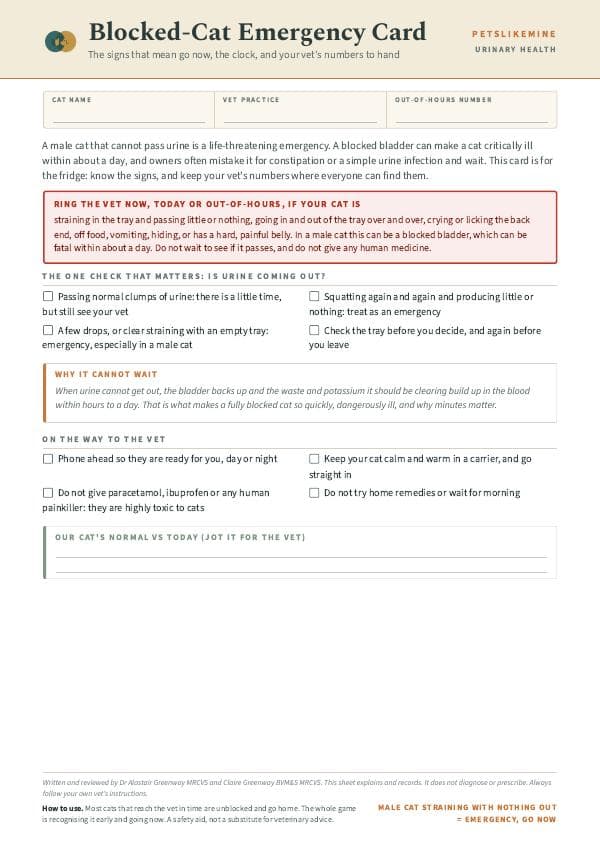
Blocked-Cat Emergency Card
PDF · 198 KBThe fridge card for the life-threatening emergency owners miss: the signs that mean go now, the make-or-break "is urine coming out?" check, why it cannot wait, and space for your vet and out-of-hours numbers.
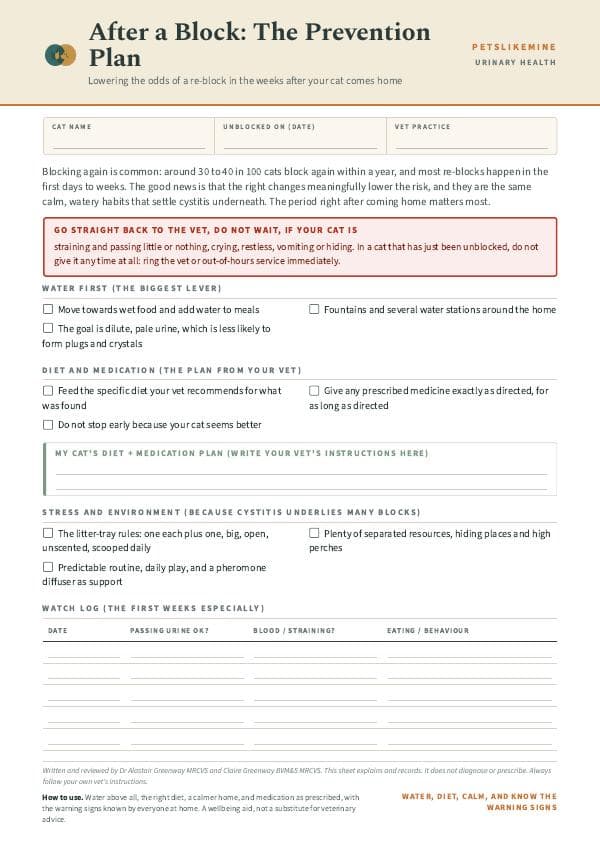
After a Block: Prevention Plan
PDF · 212 KBLowering the odds of a re-block in the high-risk weeks after a cat comes home: water, the right diet, stress and MEMO, medication as prescribed, the warning signs that mean go straight back, and a watch log.
Keep track of how your pet is doing
The owners who cope best are the ones who notice changes early. A simple health log shows you what is working, and what is not, before the next vet visit.
Start tracking, freeYou're not doing this alone
Compare treatment journeys and talk to owners managing urinary health. Free to join.
Join PetsLikeMine