

Is This an Emergency? The Blocked-Cat Signs You Must Not Wait On
Alastair Greenway
BVM&S MRCVS
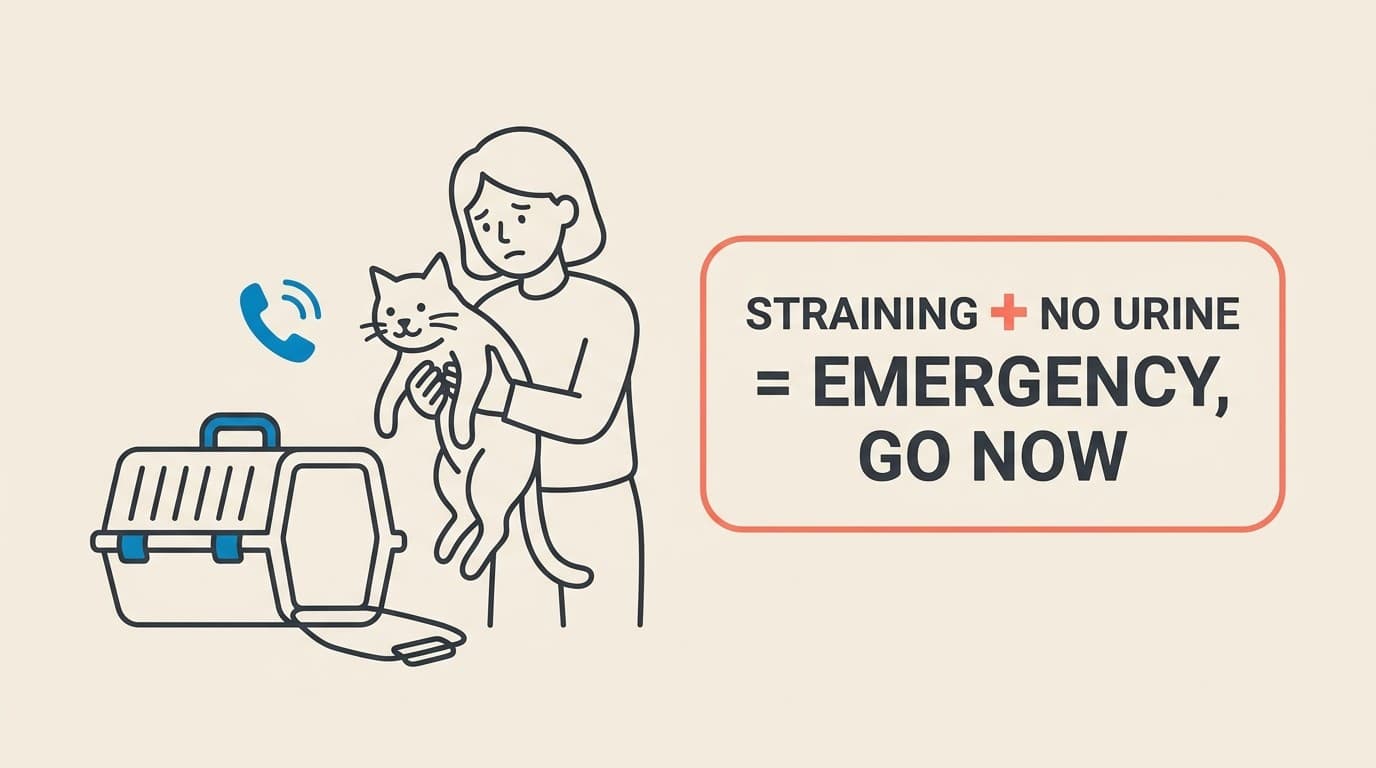
A male cat going in and out of the litter tray, straining, crying and passing little or no urine is the one scenario on this page that can't wait. If that's your cat right now, don't read to the end first. Ring your vet or the out-of-hours emergency vet now, tonight, and say "I think my male cat might be blocked." This can be a urethral obstruction, where the tube that carries urine out of the bladder gets plugged so nothing can get out, and it is one of the few genuine "go this minute" emergencies in cats. An untreated, fully blocked cat can die within about a day. It is not constipation, and it is not a simple urine infection, even though it can look like both.
That is the whole message, and everything below is here to help you tell whether this is your cat right now.
First, the one thing that decides everything: is urine actually coming out?
The single most useful thing you can do is work out whether your cat is producing urine, not just trying to.
A cat that goes to the tray, strains, and leaves a normal-sized wet clump has, for the moment, some time. Something is wrong and it still needs a vet, but the urine is getting out.
A cat, usually a male cat, that squats again and again and produces nothing, or only a drop or two, may be blocked. That cat does not have time to wait until morning.
So before anything else, go and look at the tray. Has there been a normal wee in the last several hours, a proper clump you'd recognise as your cat's usual output? Or has your cat been straining repeatedly with nothing to show for it? If you genuinely can't tell, treat it as the dangerous version and call the vet. With a blocked cat, the cost of acting "too early" is a phone call. The cost of waiting is your cat's life.
Owners very reasonably mistake this for constipation, because a blocked cat strains, hunches and looks like it's trying to pass something. The difference is what the cat is straining to do. A truly constipated cat is straining to pass faeces and is usually still weeing normally. The emergency is a cat straining to pass urine and failing. If you're not sure which it is, that uncertainty is itself a reason to ring the vet (you can read the fuller straining-cat differential in My cat is straining in the litter tray: what's going on, and what to do).
Warning signs of a block
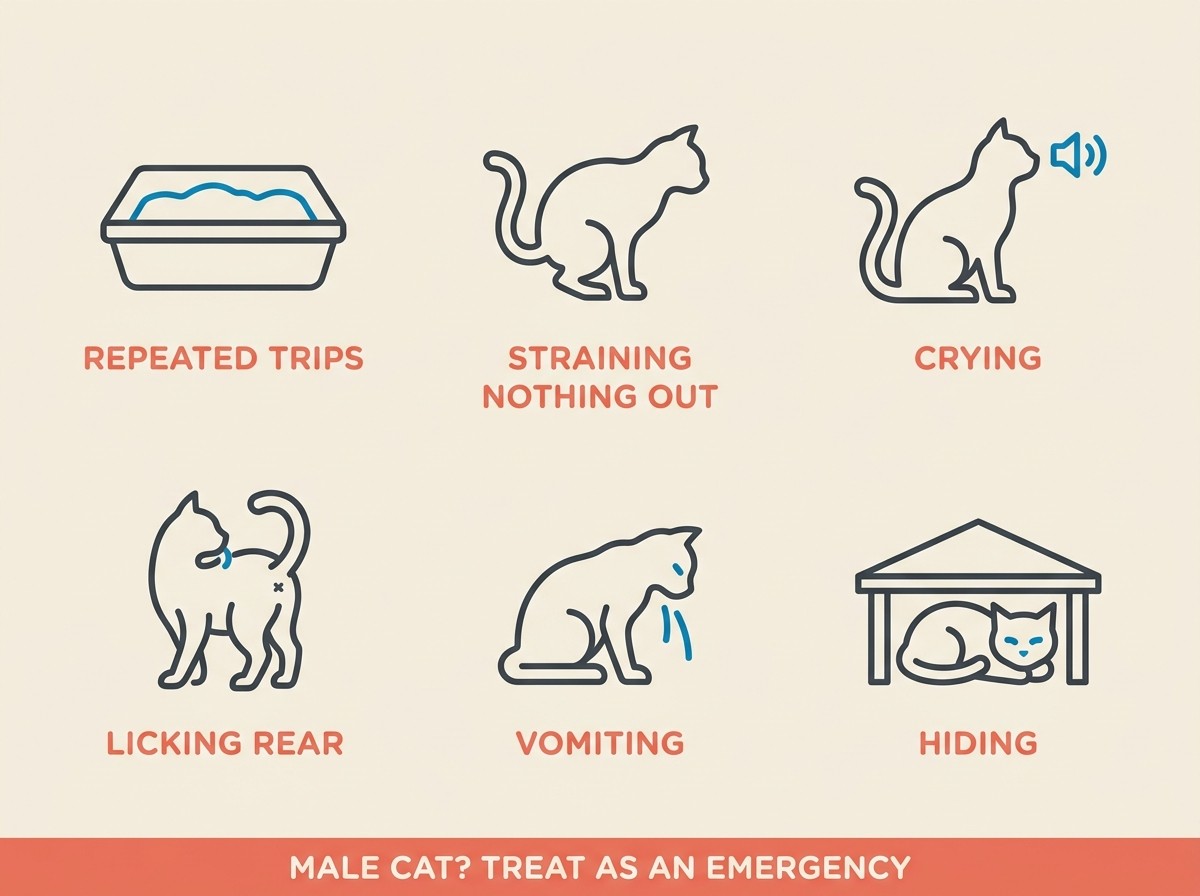
Any of these signs in a male cat means treat it as an emergency and get to a vet now. The more of them together, the more urgent it is.
- Repeated trips to the tray with little or nothing produced, in and out, in and out
- Straining or crying in the tray, or yowling around the house
- Passing little or no urine, or only a few blood-tinged drops
- Licking at the back end or the tummy, often persistently
- Restlessness and pacing, unable to settle anywhere
- Hiding away, which in cats is a classic sign of pain and feeling unwell
- Vomiting or retching, and going off food
- A hard, tense or painful belly (a blocked bladder feels like a firm, grape-to-orange-sized ball low in the tummy, and the cat usually objects to it being touched)
- Collapse, weakness or feeling cold to the touch, which are late and very serious signs
The earlier signs, the tray trips and the straining, are your window. The later ones, the vomiting, collapse and cold body, mean the block has started to poison the cat and the clock is nearly out. You do not need to wait for the later signs to act. The straining male cat passing nothing is enough on its own.
A note on why male cats. A male cat's urethra is long and narrow, and it tapers to a very fine point near the tip, so a gritty plug of crystals and mucus, a tiny stone, or simply swelling and spasm from an inflamed bladder is far more likely to lodge and block it. Females have a short, wide urethra and very rarely obstruct. Urethral obstruction occurs almost exclusively in male cats, which is why this whole page keeps saying "male cat" (2025 iCatCare consensus guidelines). It is most often seen in neutered males in middle age, but a male cat of any age can block.
Why a block is so dangerous, briefly
When the urethra is plugged, urine has nowhere to go. The bladder fills and stretches, and the back-pressure runs all the way up to the kidneys, which can't clear waste any more. Toxins build up in the blood (your vet calls this post-renal azotaemia), and critically, the level of potassium rises. Potassium directly affects the heart's rhythm, and a high enough level can slow the heart and eventually stop it (Today's Veterinary Practice). This is why a cold, slow-hearted blocked cat is in such serious trouble.
This is the bit that makes a block different from almost everything else a cat owner worries about. It is measured in hours, not days. With a complete obstruction, dangerous changes in the blood build up within roughly 24 to 48 hours (2025 iCatCare consensus guidelines), and International Cat Care puts it plainly for owners: without treatment a block can cause kidney failure and can be fatal within two to three days (International Cat Care). That is the real reason "wait and see overnight" can be a fatal plan. (For the full picture of what a block is and what treatment involves, see The blocked cat: the emergency every owner of a male cat must recognise.)
The reassuring flip side: cats that reach the vet in time do well. With prompt treatment, more than nine in ten cats survive a blocked episode to go home (Today's Veterinary Practice). Getting there in time is the entire game, and that is something you control.
What is not an emergency tonight, but still needs a vet soon
Not every cat at the tray is blocked, and it helps to know the calmer picture so you're not frightened unnecessarily.
A cat that is bright in itself, eating, and clearly passing urine, but with a pink tinge of blood in it, or one that strains a little and then settles and produces a normal wee, is most likely having a bout of cystitis or has crystals or a stone irritating the bladder. That is uncomfortable and it does warrant a prompt, non-emergency vet appointment, ideally within a day or so. It is not the same as a blocked cat, and it does not usually need an out-of-hours dash. Most cats with these signs have feline idiopathic cystitis, a stress-linked, sterile inflammation of the bladder rather than an infection (which is why it usually doesn't need antibiotics, the topic of Feline idiopathic cystitis: why stress gives your cat a sore bladder).
The two pictures can overlap, though, and a male cat with cystitis can tip over into a block. So the rule stands: if a male cat is straining and you cannot confirm he is passing a normal amount of urine, treat it as an emergency, even if he seems otherwise reasonably bright. Cats hide how ill they are, and the early hours of a block are deceptively quiet.
If your cat is unsure-but-uncomfortable and you're trying to decide how fast to move, our Blocked-Cat & Straining-Cat triage tool walks you through the same questions a vet would ask, sex, whether urine is coming out, the warning signs, and tells you whether this is a "now", a "today" or a "watch". When in doubt about a male cat, though, default to ringing the vet.
What to do on the way in
If you've decided this is an emergency, here is the short version of what helps and what to avoid.
- Ring first, then go. Phone your vet or the emergency clinic so they're ready for you, then take your cat straight in. Saying the words "I think my cat is blocked" gets you seen fast.
- Keep your cat calm and warm. Pop him gently into the carrier with a soft towel. A blocked cat is often cold and in pain, and warmth and quiet help while you travel.
- Don't try to fix it at home. There is nothing safe you can do to unblock a cat yourself. Don't press on the bladder to try to "squeeze it out", as a very full bladder can tear.
- Never give human painkillers. Paracetamol and ibuprofen are highly toxic to cats and can be fatal, even in tiny amounts, so they will make a dangerous situation far worse, not better (International Cat Care, NSAIDs and your cat). Leave all pain relief to the vet.
- Don't waste time on cranberry, "flushing" remedies or waiting for a home pee. None of these relieve a physical blockage, and the time they cost is time the cat doesn't have.
At the clinic, your vet will confirm whether the bladder is blocked, usually feeling that tense bladder and checking a blood sample, then sedate or anaesthetise your cat to pass a catheter and relieve the obstruction, followed by a few days on a drip to flush the kidneys and correct the blood chemistry (International Cat Care). It is intensive, but it is very often successful.
The hardest part of a blocked cat is that the window to act is short and the early signs are easy to talk yourself out of. So trust the simple test. A male cat, straining, passing little or nothing: that is go now, tonight, no matter the hour. You will never regret making the call that turned out to be cystitis. You might regret the one you didn't make.
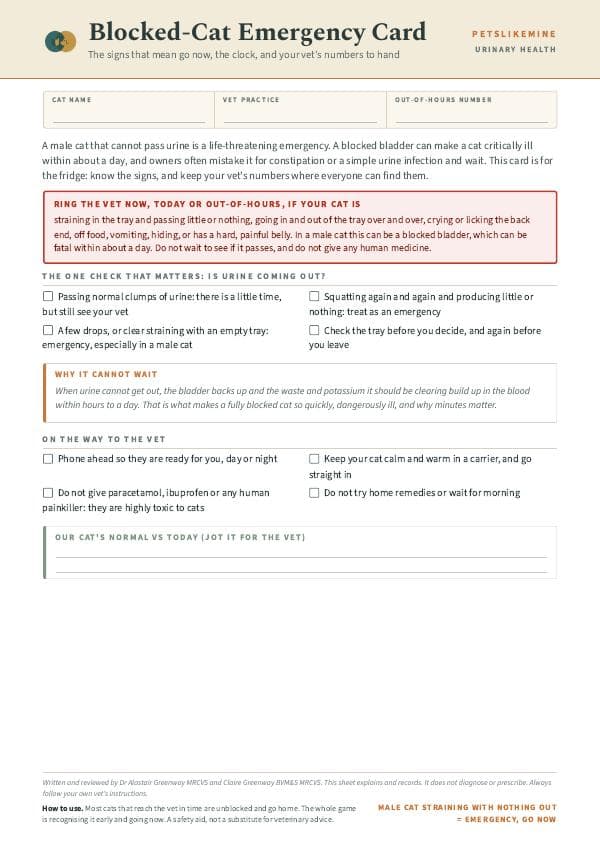
If your cat has been through a block before and you're reading this braced for the next one, the good news is that re-blocks are partly preventable, and there's a clear plan for the weeks after coming home in Will it happen again? Preventing a re-block after your cat comes home. You can also keep the blocked-cat red-flags fridge card download somewhere everyone in the house can see it, with your vet and out-of-hours numbers filled in, so nobody has to think twice next time.
References
- 2025 iCatCare consensus guidelines on the diagnosis and management of lower urinary tract diseases in cats. *Journal of Feline Medicine and Surgery* / PMC.
- International Cat Care. Urethral obstruction in cats (owner information).
- Today's Veterinary Practice. Feline Urethral Obstruction: Diagnosis and Management.
- Jones E, et al. Occurrence and clinical management of urethral obstruction in male cats under primary veterinary care in the United Kingdom in 2016. *Journal of Veterinary Internal Medicine*, 2022.
- Gerber B, et al. Recurrence rate and long-term course of cats with feline lower urinary tract disease. *Journal of Feline Medicine and Surgery* / PMC.
- International Cat Care. Non-steroidal anti-inflammatory drugs (NSAIDs) and your cat.
Free downloads
Companion worksheets to put what you've read into practice. Free PDFs, print at home.
Keep track of how your pet is doing
The owners who cope best are the ones who notice changes early. A simple health log shows you what is working, and what is not, before the next vet visit.
Start tracking, freeYou're not doing this alone
Compare treatment journeys and talk to owners managing urinary health. Free to join.
Join PetsLikeMine