

Bladder Stones in Cats and Dogs: The Two Main Types, and Why the Difference Is Everything
Alastair Greenway
BVM&S MRCVS
Bladder stones nearly always raise the same first question: does this mean surgery? It's a fair worry, and the honest answer is that it depends almost entirely on one thing, the type of stone. That single fact runs through every decision that follows.
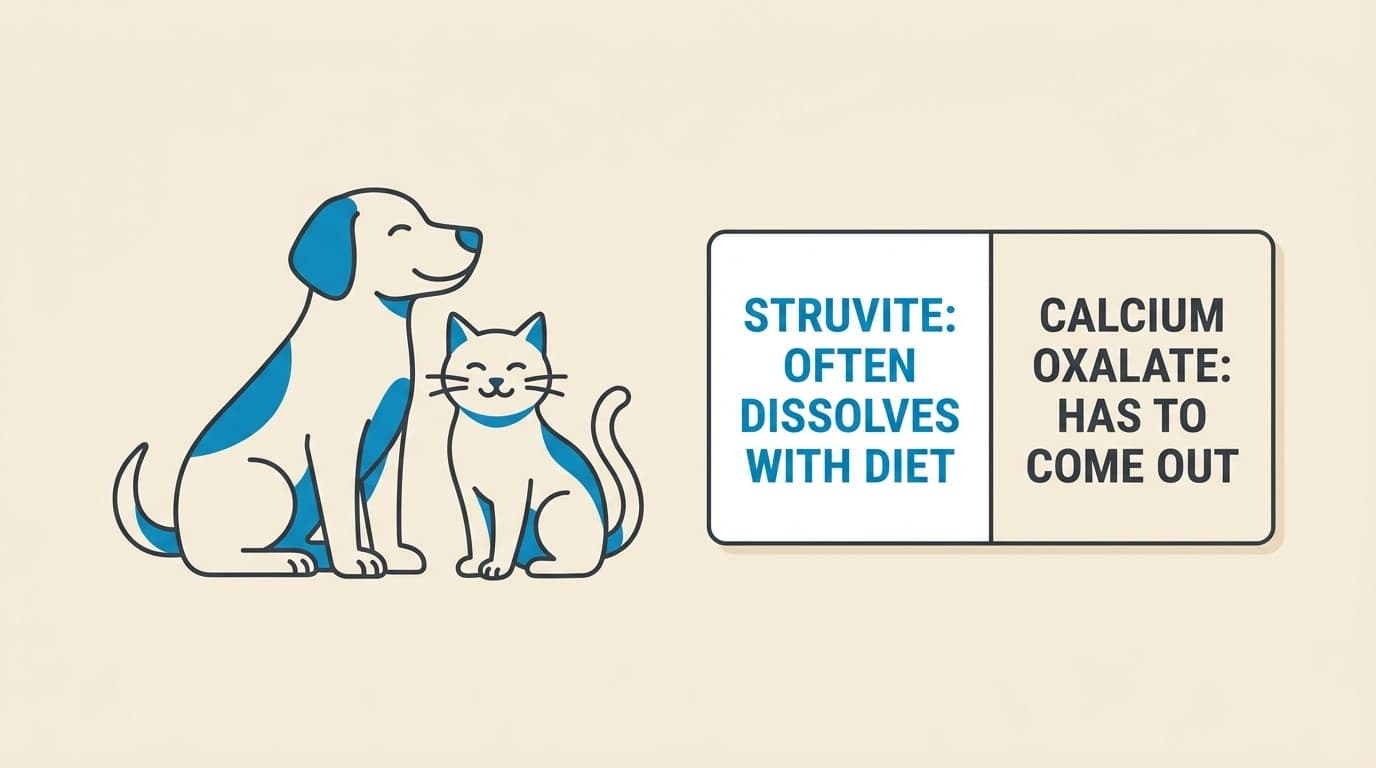
Two stones matter most, struvite and calcium oxalate, and the difference between them is not a technicality. One can often be melted away with a special diet over a few weeks, no surgery needed. The other can't be dissolved at all, ever, by any diet, and if it's causing trouble it has to come out. Knowing which your pet has is the difference between a few weeks of feeding a particular food and a trip to the operating table, which is why your vet is so keen to find out the type, and why "a urinary diet for stones" is a phrase that should make you ask "which kind?"
What bladder stones actually are
A bladder stone, or urolith if you want the proper word, starts life as microscopic crystals. Urine carries dissolved minerals, and when it becomes too concentrated, or the conditions in the bladder tip the wrong way, those minerals come out of solution and form crystals. Over time the crystals clump and harden into stones, anything from a gritty sand to a single stone the size of a marble, or dozens of smaller ones rattling around together.
The signs they cause are much the same whatever the stone is made of, because the problem is mechanical: a stone is a rough object grinding against a sensitive bladder lining. You'll typically see straining to wee, going little and often, blood in the urine (a pink tinge through to obviously bloody), licking at the back end, and sometimes weeing outside the tray or in the house. These look exactly like the signs of feline idiopathic cystitis or a urine infection, which is precisely why your vet can't tell stones apart from those just by watching your pet (see "My cat is straining in the litter tray" and "Is it a UTI?").
There is one way stones are genuinely more dangerous than a simple bout of cystitis, and it's the reason this section is wired so tightly to the emergency one. A small stone, or a plug of crystals and grit, can travel out of the bladder and lodge in the urethra, the narrow tube that carries urine out. In a male cat or a male dog that urethra is long and narrow, and a stuck stone can block it completely. A pet that is straining and passing little or nothing, especially a male cat, is a life-threatening emergency, not constipation and not a simple infection. That needs a vet today, out of hours if necessary (see "Is this an emergency? The blocked-cat signs you must not wait on" and the Blocked-Cat triage tool). Hold that thought; we'll come back to it.
The two that matter, and the decision they drive
Across cats and dogs, struvite and calcium oxalate are far and away the commonest stones. In cats the two together make up around 90% of all uroliths, and in dogs they dominate too [1][5]. Telling them apart is what changes everything.
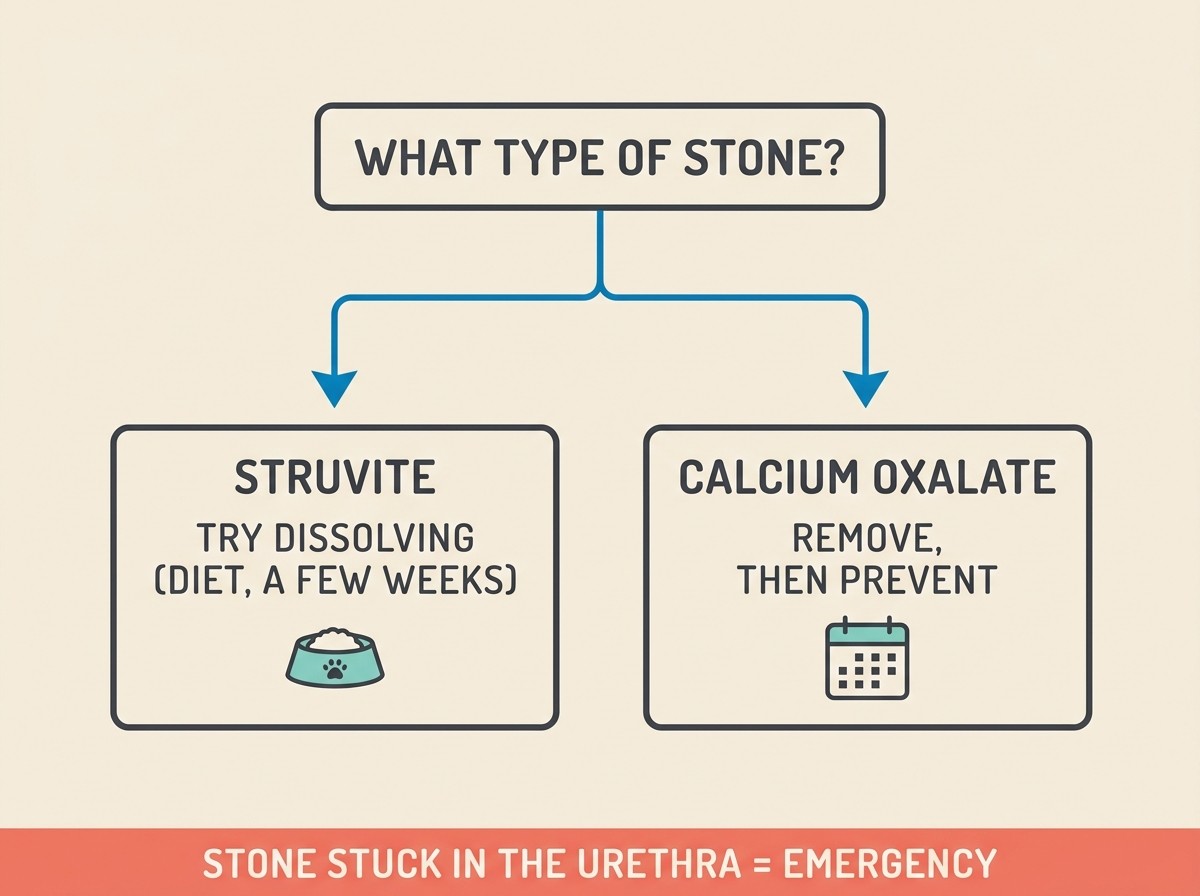
Struvite. Struvite (the full name is magnesium ammonium phosphate, if you ever see it written down) forms in urine that is too concentrated and not acidic enough. The good news, and it's genuinely good news, is that struvite stones can often be dissolved. Feeding a specially formulated diet that makes the urine more dilute and more acidic, and is low in the minerals struvite needs, can shrink and clear the stones over a matter of weeks, with no surgery at all [1][2]. The standard feline consensus guidance is that dissolution typically takes around two to three weeks, monitored with repeat imaging, though larger stones can take longer [1].
Calcium oxalate. Calcium oxalate is the awkward one. It cannot be dissolved. There is no diet, no supplement and no medicine that will make a calcium oxalate stone disappear from the bladder [2][3]. If it's small enough it might be flushed or retrieved without open surgery, but if it's causing problems it physically has to be removed, and then the whole job becomes prevention, because calcium oxalate has a frustrating habit of coming back [2].
That single fork, dissolve versus remove, is the reason your vet wants to know the type before settling on a plan. Reach for a struvite-dissolving diet when the stone is actually calcium oxalate and you'll waste weeks while the stone sits there causing harm. Assume surgery for a stone that would happily have dissolved and you've put your pet through an anaesthetic they didn't need. The type isn't trivia; it's the whole map.
Pinning down the type
Here's the slightly frustrating part: your vet often can't be completely certain of the type until the stone itself is analysed. There are good clues, though, and they're usually enough to start.
The first clues are the pet themselves and the urine. Your pet's age, sex and breed all shift the odds, and a urine test adds more, because the crystals seen under the microscope, the urine pH and whether there's an infection all point one way or the other. Imaging matters too: most struvite and calcium oxalate stones show up on a plain X-ray, while a couple of the rarer stones don't, which is itself a clue.
But the definitive answer comes from sending an actual stone off to a laboratory for analysis, either one your pet has passed naturally or one removed at surgery; quantitative analysis of the stone itself is the only way to be sure what it's made of [1][2]. That's why your vet may start treatment on a best guess, a "presumptive" diagnosis, and then adjust once the lab confirms what the stone is really made of. If a struvite-dissolving diet is shrinking the stone on the follow-up scan, that more or less confirms it was struvite; if nothing's moved after a fair trial, the thinking shifts towards oxalate and removal. It's a sensible, low-risk way to work, and it's why those follow-up checks matter.
If you can catch a passed stone or some grit at home, in a clean tray with non-absorbent litter, pop it in a clean container and take it in. It can save a lot of guesswork (see "How to describe urinary signs to your vet, and how to collect a urine sample").
How cats and dogs differ
The balance of stone types isn't the same in cats and dogs, and it isn't even the same from decade to decade.
In cats, struvite and calcium oxalate are both common. For a long stretch from the 1980s onwards, oxalate became steadily more common while struvite declined, a shift widely linked to the spread of acidifying, magnesium-restricted cat foods designed to head off struvite [4][5]. More recently the pendulum has swung part of the way back, and recent figures suggest struvite is once again at least as common as oxalate in cats [1]. The practical message is the same either way: don't assume, find out.
In dogs, there's an important wrinkle with struvite. Canine struvite stones are very often driven by a urinary infection. Certain bacteria (staphylococci and Proteus are the usual culprits) produce an enzyme called urease that turns the urine alkaline and effectively manufactures the conditions struvite needs [6][7]. This is why, in dogs, treating the infection is part of treating the stone, and why your vet will want a urine culture. It's also why struvite turns up most in young, female, small-breed dogs, the same dogs who tend to pick up more urinary infections in the first place [7]. Calcium oxalate in dogs, by contrast, has a strong breed and genetic streak: small breeds such as the Miniature Schnauzer and Bichon Frise carry many times the risk of the average dog, along with the Shih Tzu, Lhasa Apso, Yorkshire Terrier and several others [8] (the rarer stones, and their breed links, get their own piece in "The other stones: urate, cystine and the breed and liver links").
What treatment looks like, in outline
Once the type is known, or strongly suspected, the path is fairly clear.
If it's struvite, the first move is usually dissolution: a prescription dissolving diet, fed strictly and exclusively for several weeks, with repeat imaging to watch the stones shrink, plus antibiotics if an infection is driving it in a dog [1][2][7]. It asks for discipline (no treats, no other food, because one cheated meal undoes the chemistry), but the payoff is avoiding surgery altogether. The detail of how this works, the timeline and when dissolution isn't the right call lives in "Dissolving struvite stones with diet, and when surgery is needed instead".
If it's calcium oxalate, or if any stone is causing a blockage, won't dissolve, or is simply too big to wait on, it comes out. That doesn't always mean open surgery. Depending on the size of the stone, the size of your pet and what your vet or a referral centre offers, options range from flushing small stones out under sedation (voiding urohydropropulsion), through minimally invasive techniques like laser lithotripsy and keyhole retrieval, to a traditional bladder operation (cystotomy) [9][10]. Smaller stones in particular can sometimes be dealt with without a single stitch in the bladder. After removal, the work shifts to prevention for life, because the tendency that made the stone is still there (see "Calcium oxalate stones: prevention when you can't dissolve them" and "Diet and water for a stone-forming pet").
Whichever stone your pet has, one thing helps with every type: dilute urine. Getting more water through the bladder makes crystals less likely to form in the first place, and the consensus guidance leans hard on a high-moisture diet and increased water intake to keep stones from recurring [2]. It is the cheapest and most useful thing you can do, and it pulls double duty across stones, cystitis and block prevention (see "Why getting more water in is the best thing you can do for your pet's bladder" and the FIC & Water tracker).
Don't forget the emergency overlap
It's worth saying again, because it's the one part of stone disease that can't wait. A stone or a plug of grit that lodges in the urethra and blocks the flow of urine is an emergency in any pet, and a genuine race against the clock in a male cat, where a complete blockage poisons the body and can become life-threatening within a day or two [11][12]. If your pet, and especially a male cat, is straining repeatedly and producing little or nothing, crying, off their food, vomiting or hiding, don't wait to see if it settles. Ring your vet or the emergency service now (see "Is this an emergency? The blocked-cat signs you must not wait on", "When a stone causes a blockage: the bridge to the emergency", and the Blocked-Cat triage tool, and keep the blocked-cat red-flags fridge card somewhere obvious).
One question to ask your vet
The question to put to your vet is "What type is it, and can it be dissolved?" That single answer shapes everything that comes next, whether your pet faces a few weeks of a special diet or a procedure to remove the stone, and what their prevention plan looks like for the rest of their life. It's common, it's manageable, and with the type pinned down you and your vet can make the right call rather than a guess.
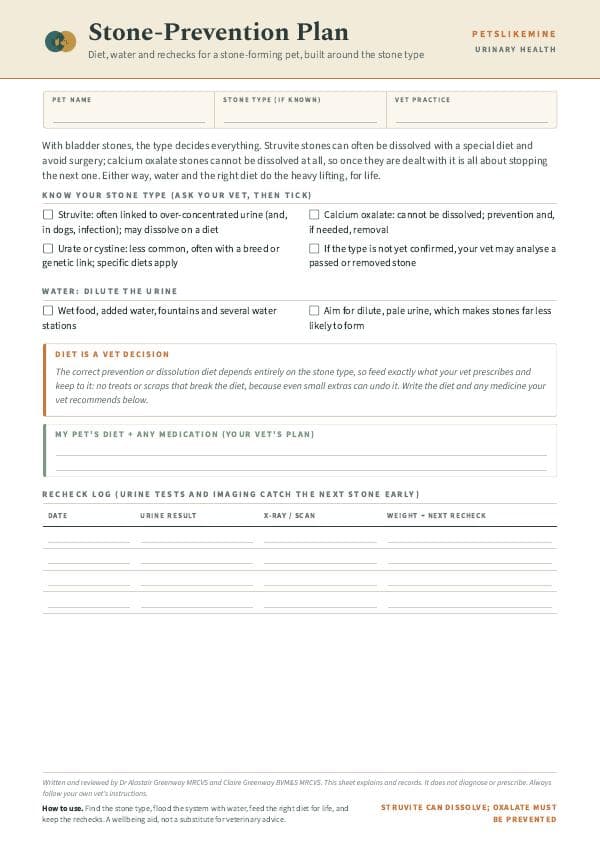
From here, the natural next steps are "Dissolving struvite stones with diet, and when surgery is needed instead" if your pet has struvite, "Calcium oxalate stones: prevention when you can't dissolve them" if it's oxalate, and "Diet and water for a stone-forming pet: the prevention plan for life" once you're past the immediate problem and thinking about keeping the next stone from ever forming.
References
- Hindar C, et al. 2025 iCatCare consensus guidelines on the diagnosis and management of lower urinary tract diseases in cats. *Journal of Feline Medicine and Surgery.*
- Lulich JP, Berent AC, Adams LG, Westropp JL, Bartges JW, Osborne CA. ACVIM Small Animal Consensus Recommendations on the Treatment and Prevention of Uroliths in Dogs and Cats. *J Vet Intern Med.* 2016;30(5):1564-1574. (DOI: 10.1111/jvim.14559)
- Calcium Oxalate Bladder Stones in Cats. VCA Animal Hospitals.
- Osborne CA. State of the Stone: Epidemiological Shifts in Feline Urolith Type (WSAVA 2008). VIN.
- Feline Struvite and Calcium Oxalate Urolithiasis. *Today's Veterinary Practice.*
- What bacteria cause infection-induced struvite stones, which are common in dogs? Minnesota Urolith Center, University of Minnesota College of Veterinary Medicine.
- Struvite bladder stones in dogs. Cornell University College of Veterinary Medicine, Riney Canine Health Center.
- Calcium Oxalate Urinary Stones. Canine Genetics Lab, University of Minnesota College of Veterinary Medicine.
- Noninvasive Methods for Removing Cystoliths in Small Animals. *Today's Veterinary Nurse.*
- Laser Lithotripsy in Small Animal Veterinary Medicine. Royal Veterinary College.
- Urethral Obstruction in Small Animals. MSD/Merck Veterinary Manual.
- Summary of the ACVIM Consensus Recommendations on the Treatment and Prevention of Uroliths in Dogs and Cats. MSPCA-Angell.
Free downloads
Companion worksheets to put what you've read into practice. Free PDFs, print at home.
Keep track of how your pet is doing
The owners who cope best are the ones who notice changes early. A simple health log shows you what is working, and what is not, before the next vet visit.
Start tracking, freeYou're not doing this alone
Compare treatment journeys and talk to owners managing urinary health. Free to join.
Join PetsLikeMine