

Bladder or Kidneys? When Urinary Signs Point Higher Up
Alastair Greenway
BVM&S MRCVS
Trips to the tray, wet patches on the floor, a pet that won't leave the tap alone: most urinary worries are a bladder story, and most of this Urinary Health home is about the bladder and the urethra. Cystitis, stones, the blocked cat, the leaking dog. But every so often the picture isn't really about the bladder at all. It's pointing higher up, to the kidneys, and that's a different conversation with a different work-up and a different home on this site.
Think of this page as the boundary marker. It's here to help you spot the moment when "a urinary problem" is really "a kidney problem", because the two get muddled all the time, by owners and by search engines, and they're treated in completely different ways. The headline is simple: the bladder is not the kidney, and one particular pattern, an older pet drinking a lot more, weeing a lot more and quietly losing weight, points at the kidneys, not at a sore bladder.
A quick map of the plumbing
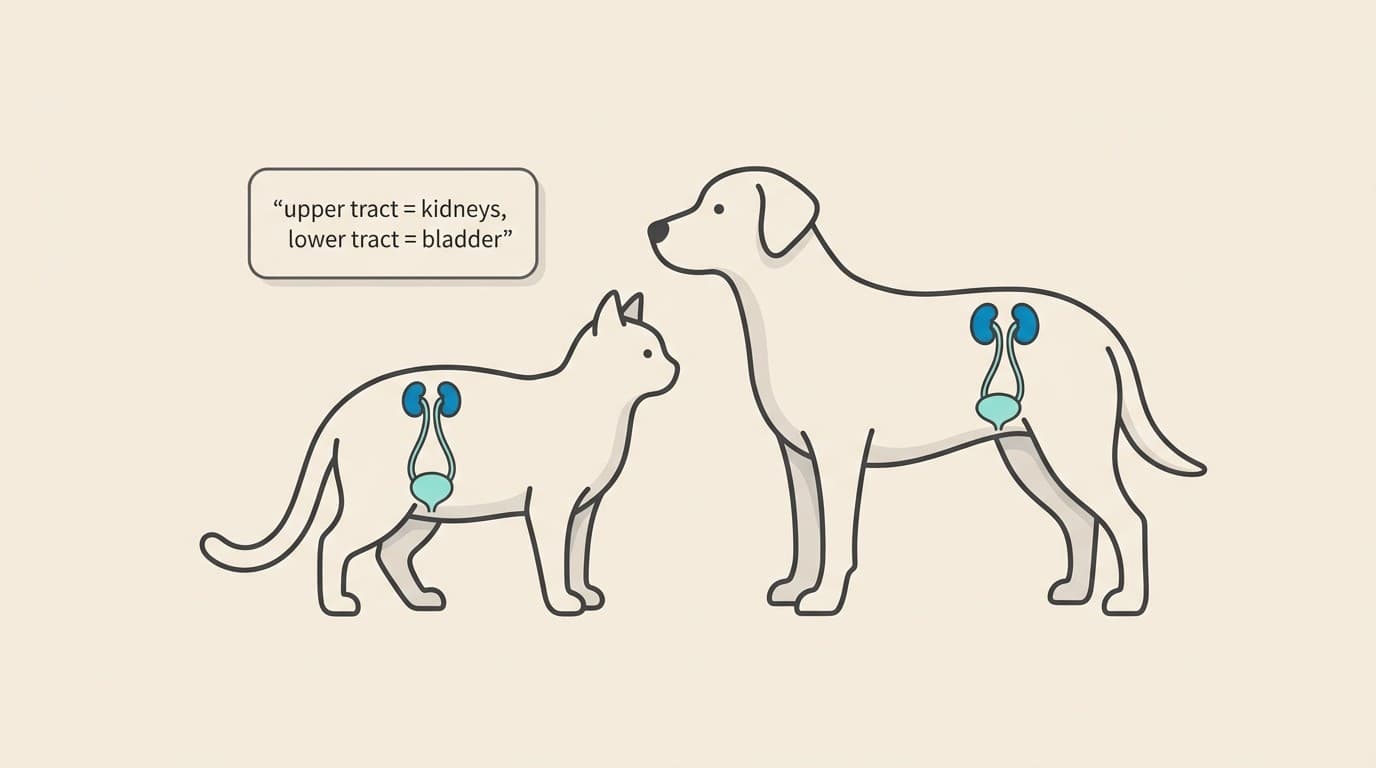
Picture the urinary tract as two floors of the same building. Vets split it into the upper urinary tract, the kidneys and the two ureters (the thin tubes that carry urine down from each kidney), and the lower urinary tract, the bladder and the urethra (2025 iCatCare consensus guidelines; Merck Veterinary Manual). The kidneys make and clean the urine; the bladder simply stores it and passes it.
Each floor announces a problem in its own way, and that's why the split matters. A problem downstairs makes the act of weeing go wrong: straining, frequent small amounts, blood, pain, weeing in odd places. A problem upstairs makes the volume go wrong: the kidneys lose their grip on water, so a pet pees out far too much and drinks hard to keep up. Almost everything else in this home is a downstairs problem. This page is about spotting an upstairs one.
The pattern that points at the kidneys
There's a classic triad that should make you think kidney rather than bladder, especially in an older animal:
- Drinking much more than usual (your vet calls this polydipsia)
- Weeing much more than usual, large puddles or a tray that needs emptying far more often (polyuria)
- Losing weight, often slowly, sometimes with a poorer appetite or a duller coat
Put those three together in a middle-aged or senior pet and you're very probably not looking at a bladder problem at all. The commonest causes of "drinking and weeing more" are the big internal diseases: in cats, chronic kidney disease, diabetes and an overactive thyroid (hyperthyroidism); in dogs, chronic kidney disease, diabetes and Cushing's disease (Today's Veterinary Practice, stepwise approach to PU/PD). Notice that bladder disease isn't on either list. Cystitis and stones make a cat strain and pass small amounts; they don't make a cat empty the water bowl.
Of those, chronic kidney disease (CKD) is the one this page hands off most often, because it's so common in older pets. CKD affects only around 1 to 3% of cats in general, but roughly 20 to 50% of cats over ten have some degree of it, and the figure climbs higher still past fifteen (Epidemiology of CKD in Cats, Life 2025). It's commonly quoted that as many as one in three cats will develop kidney disease in their lifetime (IDEXX / IRIS estimate). It's less of a problem in dogs, reported in up to around 3% of the general dog population (canine CKD prevalence reviews). The weight loss is an early clue worth taking seriously: in one large study, cats later diagnosed with CKD had lost a median of about 11% of their body weight in the 6 to 12 months before diagnosis, far more than cats that stayed well (Greene et al., JAVMA 2014). A slowly shrinking older cat who's drinking more is a cat to get checked sooner rather than later, and the right place to read on then isn't here, it's our kidney (chronic kidney disease) guidance, which covers diagnosis, diet, the IRIS stages and day-to-day management in proper depth. This page just gets you to the right door.
How much is "drinking more", really?
"He seems to be drinking more" is one of the most useful things you can tell a vet, and one of the easiest to talk yourself out of. Here's a rough yardstick: a healthy cat takes in up to about 50 ml of water per kilogram of body weight a day, and a healthy dog roughly 50 to 60 ml/kg, so consistently more than that is a sign worth noting. Vets treat anything over 100 ml/kg/day in either species as definite polydipsia (Today's Veterinary Practice; dvm360, PU/PD). For a 4 kg cat that 100 ml/kg line is about 400 ml a day; for a 20 kg dog, around 2 litres.
You don't need to be exact. If you can't tell, measure it: fill the bowl with a known amount, top it up from a measuring jug, and tot up the total over 24 hours (counting wet food and any other water sources). A few days of rough numbers beats a hunch, and it's exactly what the FIC & Water tracker is built to log. One caveat, a pet on dry food drinks more than one on wet food anyway, hot weather and exercise add to it, and these figures come from laboratory animals, so a clear change from your pet's own normal matters more than any particular number (dvm360, PU/PD).
Reading the signs: downstairs versus upstairs
Here's the contrast in one place. It's not a test you can finish at home, but it tells you which way to lean.
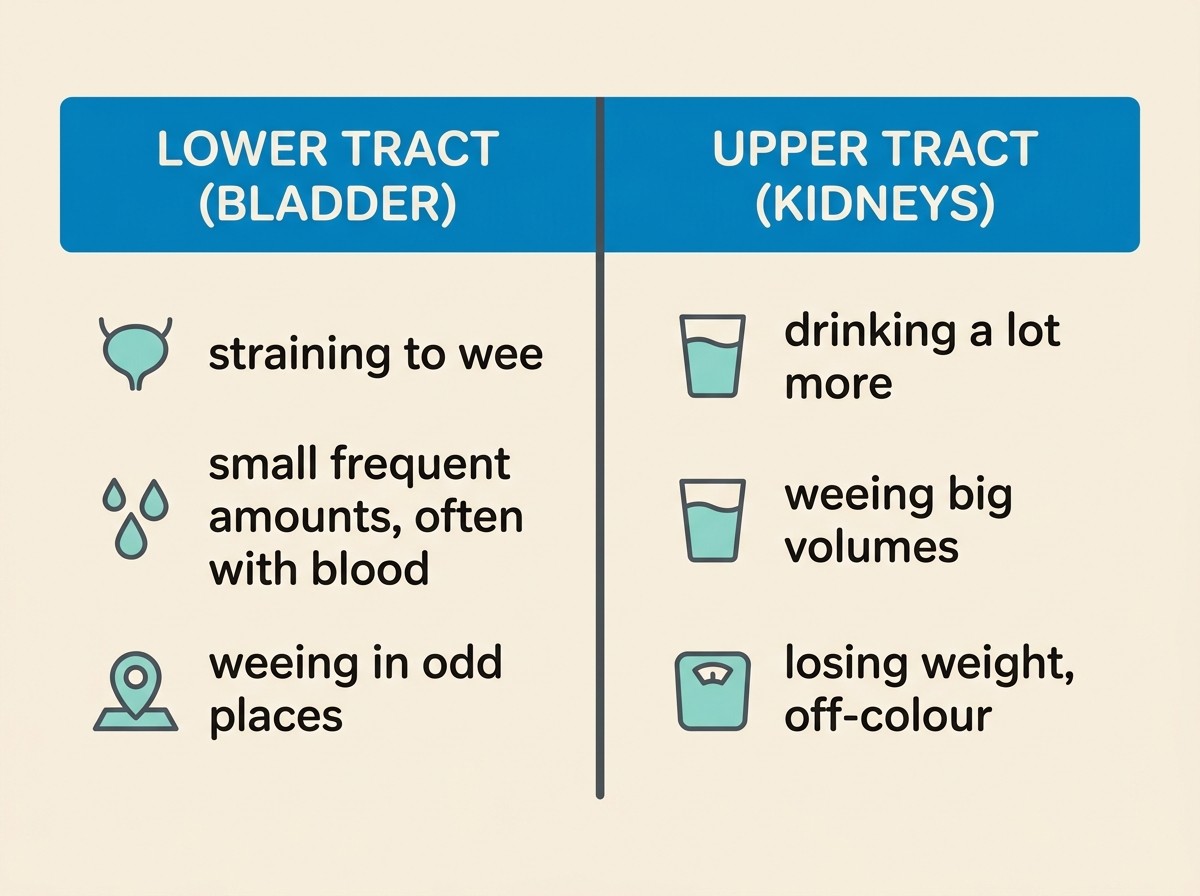
With a lower urinary tract problem (the bladder, most of this home) it's the act of weeing that's gone wrong: straining, frequent small wees, blood, accidents, and, in a male cat, the one true emergency, straining and passing little or nothing (2025 iCatCare consensus guidelines). With an upper urinary tract problem (the kidneys) the act is usually fine but the amount is wrong, alongside whole-body signs, big thirst, weight loss, a poorer appetite, lethargy, sometimes vomiting or bad breath as things progress (ISFM CKD consensus, Sparkes et al. 2016).
Blood in the urine is the one sign that confuses people. Usually it comes from an irritated bladder downstairs, but it can occasionally come from a stone, cyst, tumour or bleeding higher up in the kidney itself (2025 iCatCare consensus guidelines; Lower Urinary Tract Neoplasia review, Vet Sci), so blood alone doesn't tell you which floor. One more reason a urine test is so useful, and our piece on blood in your pet's urine walks through it in detail.
Where the line gets blurred
Real life isn't always tidy, and three situations sit right on the bladder-kidney boundary.
The older cat whose "UTI" is really a sign of something bigger. We say all over this site that a true bladder infection is uncommon in young, healthy cats (most feline "cystitis" is the stress syndrome FIC, not an infection, which is why antibiotics so often don't help, see "Is it a UTI?"). But that flips with age and illness. Older cats, and especially cats with kidney disease, diabetes or an overactive thyroid, genuinely do get real bacterial infections: positive urine cultures are reported in roughly a fifth to a quarter of cats with CKD, and around one in eight cats with diabetes or hyperthyroidism (Dorsch et al., J Feline Med Surg 2019). So in a senior cat a confirmed infection is often a flag to look for the disease underneath it, which may well be a kidney or hormone problem, and it's why a vet may run a urine culture and bloods even when the cat seems otherwise well.
Pyelonephritis, a kidney infection. Sometimes an infection climbs from the bladder up to the kidney itself, and it's sneaky: rather than the obvious straining of cystitis, it tends to show up as vague, whole-body illness, off food, flat, vomiting, occasionally a fever or kidney pain, though in many cats even those signs are absent (Dorsch et al., 2019; Merck Veterinary Manual). It matters because it can damage the kidneys and tip a cat into, or worsen, CKD, so it needs proper diagnosis rather than guesswork.
A stone stuck in a ureter, not the bladder. Stones can lodge in a ureter, the thin tube from the kidney, blocking the drainage from that one kidney. In cats this is now a recognised cause of sudden kidney injury, and the great majority of these upper-tract stones (well over 90% in published series) are calcium oxalate, the type that can't be dissolved with a diet and so usually needs surgery or a specialist procedure (Kennedy and White, J Feline Med Surg 2022; Geddes et al., J Vet Intern Med 2023). Vets sometimes call the ultrasound picture a "big kidney, little kidney". The signs are frustratingly vague again, weight loss, vomiting, going off food, so a cat who seems "off" with subtle urinary changes earns a scan, not just a urine dip. (For how stone type drives everything, see bladder stones in cats and dogs: the two main types.)
What this means for your pet, and what the vet will do
If your pet's signs are the downstairs kind, straining, small frequent wees, blood, accidents, in a cat that's otherwise eating, drinking normally and holding its weight, you're almost certainly in the right place. Start with the straining-cat or the blood-in-urine pieces, and remember the one red line that overrides everything: a male cat straining and passing little or nothing is a life-threatening emergency, not a UTI and not constipation, so ring your vet or the out-of-hours service straight away or run the Blocked-Cat triage tool.
If the picture is the upstairs kind, the older pet drinking a lot, weeing big volumes and losing weight, then the next step isn't a urinary diet or a wait-and-see. It's a vet visit with blood tests and a urine sample. A urine concentration test (the specific gravity) plus a blood panel sorts most of this out quickly: well-concentrated urine makes a kidney cause unlikely, while dilute urine alongside the right blood changes points towards CKD or one of the hormone diseases (Today's Veterinary Practice, PU/PD). Bringing a fresh urine sample makes that work-up faster and cheaper (see how to describe urinary signs to your vet and collect a sample, and the urine sample collection how-to download). Whatever the cause, more water never hurts while you wait for answers, and in true kidney disease free access to water is genuinely important, so never restrict it (ISFM CKD consensus, Sparkes et al. 2016). The full water playbook is in why getting more water in is the best thing you can do for your pet's bladder.
Noticing that the story doesn't quite fit a bladder problem is doing your pet a real favour. Kidney disease caught early is far more manageable than kidney disease found late, and the same goes for diabetes and thyroid disease. So if your older cat or dog is drinking more, weeing more and losing weight, treat that as its own thing, book the bloods, and head over to our chronic kidney disease guidance. The bladder pages will still be here if it turns out to be a false alarm.
References
- Taylor S, Boysen S, Buffington T, et al. 2025 iCatCare consensus guidelines on the diagnosis and management of lower urinary tract diseases in cats. *Journal of Feline Medicine and Surgery*. 2025. (PMC: https://pmc.ncbi.nlm.nih.gov/articles/PMC11816079/)
- Sparkes AH, Caney S, Chalhoub S, Elliott J, Finch N, Gajanayake I, Langston C, Lefebvre HP, White J, Quimby J. ISFM Consensus Guidelines on the Diagnosis and Management of Feline Chronic Kidney Disease. *Journal of Feline Medicine and Surgery*. 2016;18(3):219–239.
- A Stepwise Diagnostic Approach to Polyuria and Polydipsia (the common causes of PU/PD in dogs and cats; the >100 ml/kg/day polydipsia and >50 ml/kg/day polyuria definitions; urine specific gravity interpretation). *Today's Veterinary Practice*.
- The ins and outs of polyuria and polydipsia (normal water-intake guidelines, healthy dogs ~50–60 ml/kg/day and healthy cats up to ~45–50 ml/kg/day, polydipsia >100 ml/kg/day, with the laboratory-animal caveat). *dvm360*.
- Greene JP, Lefebvre SL, Wang M, Yang M, Lund EM, Polzin DJ. Risk factors associated with the development of chronic kidney disease in cats evaluated at primary care veterinary hospitals (median weight loss 10.8% in the 6–12 months before diagnosis, considerably higher than in cats without CKD; PU/PD, vomiting, anorexia and halitosis as presenting clues). *Journal of the American Veterinary Medical Association*. 2014;244(3):320–327.
- Grecu M, Capotă R, Horhogea C, Rîmbu C, Năstasă V, Tănase O. Epidemiology of Chronic Kidney Disease (CKD) in Cats: An Analysis of the Factors Involved (general prevalence 1–3%, 20–50% in cats over 10 years, >30% in geriatric cats; demographic risk factors). *Life (Basel)*. 2025.
- Dorsch R, Teichmann-Knorrn S, Sjetne Lund H. Urinary tract infection and subclinical bacteriuria in cats: a clinical update (positive urine cultures in ~22–29% of cats with CKD and ~12–13% with diabetes/hyperthyroidism; lower UTI vs pyelonephritis signs). *Journal of Feline Medicine and Surgery*. 2019;21(11):1023–1038.
- Pyelonephritis in Small Animals (kidney infection: ascending from the lower tract, often non-specific signs, renal pain and pyrexia frequently absent). *Merck Veterinary Manual*.
- Kennedy AJ, White JD. Feline ureteral obstruction: a case-control study of risk factors (2016–2019). *Journal of Feline Medicine and Surgery*. 2022.
- Geddes RF, Davison LJ, Elliott J, Syme HM, O'Neill DG. Risk factors for upper urinary tract uroliths and ureteral obstruction in cats under referral veterinary care in the United Kingdom (calcium oxalate the predominant upper-tract composition; non-dissolvable; vague systemic signs; the "big kidney, little kidney" picture). *Journal of Veterinary Internal Medicine*. 2023;37(2):567–577.
- Lulich JP, Berent AC, Adams LG, Westropp JL, Bartges JW, Osborne CA. ACVIM Small Animal Consensus Recommendations on the Treatment and Prevention of Uroliths in Dogs and Cats (struvite often dissolvable with diet, calcium oxalate not; upper-tract stone management). *Journal of Veterinary Internal Medicine*. 2016;30(5):1564–1574. (PMC: https://pmc.ncbi.nlm.nih.gov/articles/PMC5032870/)
- Cornell Feline Health Center. Feline Lower Urinary Tract Disease (lower vs upper tract framing; idiopathic cystitis as the commonest cause; urethral obstruction a true emergency, death possible within 24–48 hours; diagnostic approach). Cornell University College of Veterinary Medicine.
- Lower Urinary Tract Neoplasia (urinary tract tumours, chiefly transitional cell carcinoma, cause haematuria, stranguria and dysuria, and can arise in the upper as well as the lower tract). *Veterinary Sciences*. 2018;5(4):96. (PMC: https://pmc.ncbi.nlm.nih.gov/articles/PMC6313859/)
- Cornell Feline Health Center. Chronic Kidney Disease (the widely quoted estimate that as many as one in three cats will develop kidney disease in their lifetime; IDEXX / IRIS figure). Cornell University College of Veterinary Medicine.
Keep track of how your pet is doing
The owners who cope best are the ones who notice changes early. A simple health log shows you what is working, and what is not, before the next vet visit.
Start tracking, freeYou're not doing this alone
Compare treatment journeys and talk to owners managing urinary health. Free to join.
Join PetsLikeMine