

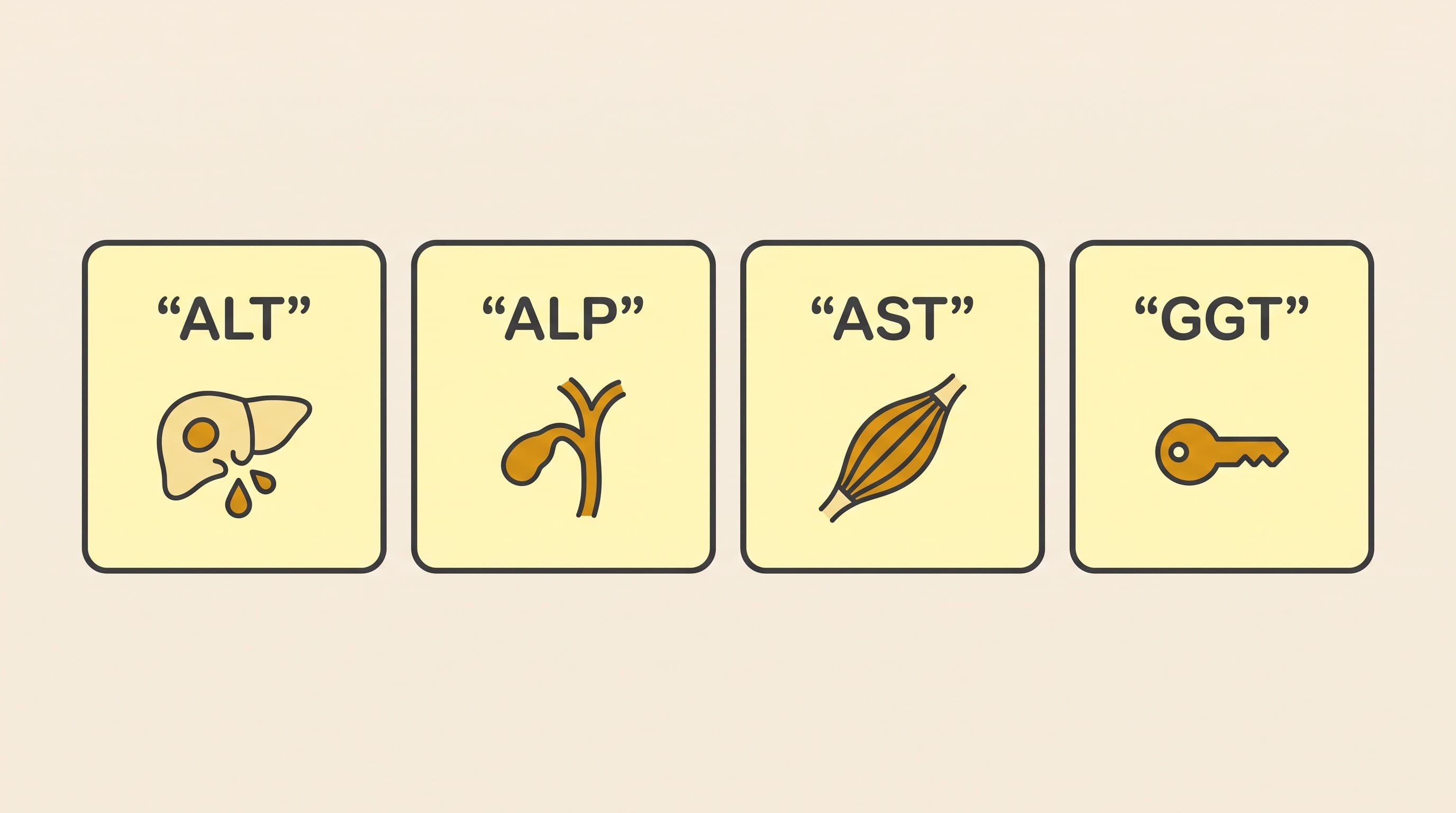
ALT, ALP, AST and GGT in Plain English
Alastair Greenway
BVM&S MRCVS
You've got the printout in front of you, and it's a wall of three-letter abbreviations with numbers beside them, some flagged, some not. Somewhere in there are the "liver enzymes" your vet mentioned, and you'd quite like to know what each one actually means before you either panic or convince yourself it's nothing. That's a completely reasonable thing to want, and it's genuinely learnable in a few minutes.
Here's the promise of this piece: by the end, you'll be able to look at ALT, ALP, AST and GGT and understand what each is telling you, why they don't all mean the same thing, and why a raised ALP in particular is so often not about the liver at all. If you arrived here in a panic about a single flagged number, our companion piece [Your dog's liver enzymes are high: what it actually means] meets that moment head-on. This piece is the calmer, letter-by-letter guide for when you want to understand the printout itself.
First, the idea that makes all four make sense: leak versus function
Before the individual letters, one concept ties them together. These four are all leakage and induction markers. They rise when liver cells are irritated and spilling their contents, or when the liver ramps up production of an enzyme. What they do not directly measure is whether the liver is doing its job.
The liver's actual work is measured elsewhere on the same panel, by the function markers: albumin, glucose, urea, bilirubin and clotting. A dog can have high enzymes and a perfectly functional liver, or a struggling liver with unremarkable enzymes. So as you read the four enzymes below, hold this in mind: they tell you something is going on with, or around, the liver cells. They do not by themselves tell you the liver is failing. That distinction takes a lot of the fear out of a flagged enzyme.
ALT: the "liver-cell damage, now" enzyme
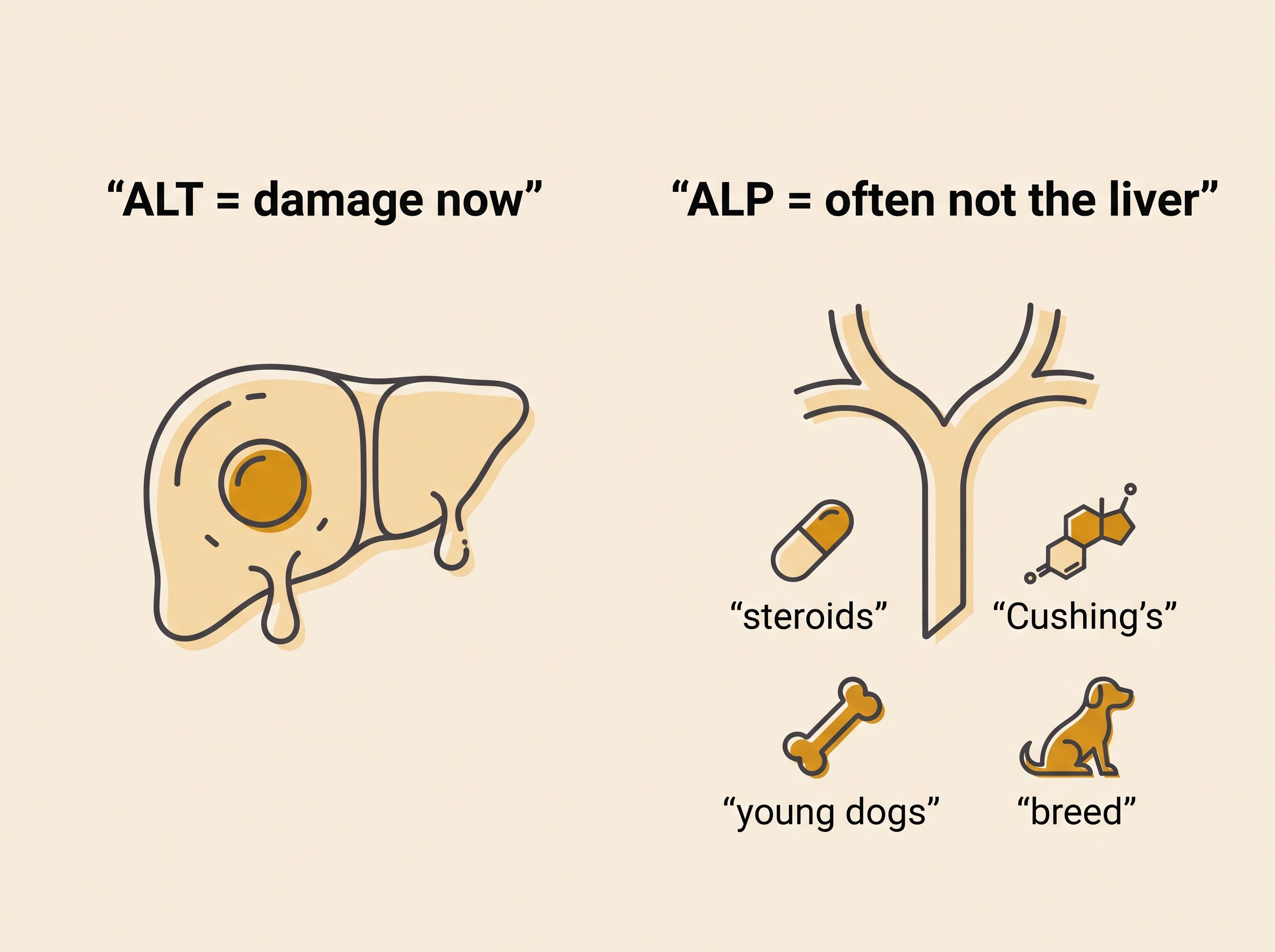
ALT (alanine aminotransferase) is the one to take most literally as a liver signal. It lives inside liver cells, so when liver cells are injured or irritated, ALT leaks into the blood. A meaningfully raised ALT is a fairly direct message that liver cells themselves are being affected at this moment.
Two useful nuances:
- Magnitude gives a rough sense of how much is leaking, not how well the liver is working. A very high ALT means a lot of cells are leaking; it does not automatically mean liver failure, because leak and function are different things.
- ALT rises and falls over time, so it's a good enzyme to recheck. A single high value is a snapshot; a series tells you whether things are improving, stable or worsening.
If ALT is the flagged value, that's the reading that most reliably points at the liver itself, and it's worth following up rather than dismissing. But following up usually means a sensible recheck and a look at the wider picture, not immediate alarm.
ALP: the complicated one, and often not the liver at all
ALP (alkaline phosphatase) is where most owners get frightened unnecessarily, because it's the enzyme most likely to be flagged and the one least likely to mean liver disease on its own. ALP rises with problems in bile flow (cholestasis), but it's produced in several tissues and switched on by several triggers, so a raised ALP has a long list of innocent explanations:
- Steroids. Dogs produce a distinct steroid-induced isoenzyme of ALP, so any dog on steroid medication (tablets, some skin or ear preparations, injections) or with excess natural steroid can run a high ALP.
- Cushing's disease (hyperadrenocorticism), where the body overproduces natural steroid, very commonly elevates ALP. A high ALP is one of the classic prompts to consider Cushing's, especially alongside increased drinking and a pot-bellied look. Our [Cushing's, thyroid disease and the gallbladder link] piece explores that connection.
- Bone. ALP is also made by bone-forming cells, so young, growing dogs normally have a higher ALP, and it can rise with some bone conditions.
- Breed-benign elevations. Some Scottish Terriers, Siberian Huskies and Miniature Schnauzers carry a high ALP for life with no liver disease at all. In these breeds, an isolated high ALP is often not worth chasing.
- Other drugs and some chronic illnesses can nudge it up too.
The practical takeaway: a lone, mildly raised ALP in a well dog, particularly one on steroids, an older dog, a growing puppy, or one of those breeds, is often the most reassuring pattern of all. It's very different from a rising ALT. This is the single most common way owners are frightened by a number that, in context, is fairly benign.
AST: the rougher parallel that isn't only about the liver
AST (aspartate aminotransferase) behaves a bit like ALT, rising when cells are damaged, but it's less liver-specific. AST is found in meaningful amounts in muscle as well as liver, so a raised AST can reflect muscle injury, strenuous activity, or even a slightly awkward blood sample, not just liver trouble.
Because of that, AST is usually read alongside ALT rather than on its own. If ALT and AST both rise together, that's more supportive of a liver origin. If AST is up but ALT is normal, your vet may look toward muscle rather than liver. It's a helpful supporting player, not the lead.
GGT: ALP's companion, and the tie-breaker for bile-flow problems
GGT (gamma-glutamyl transferase) tends to move in the same direction as ALP and is associated with bile flow and cholestasis. Its real usefulness is as a tie-breaker alongside ALP.
The general logic: because ALP has all those non-liver causes (steroids, bone, breed), a raised ALP with a raised GGT leans the interpretation more toward a genuine bile-flow or liver-and-biliary problem, whereas a raised ALP with a normal GGT is more consistent with the innocent causes like steroid effect or bone. GGT also has particular value in cats, where the ALP and GGT relationship helps distinguish different feline liver diseases (our piece [High liver values in cats] covers why the feline picture is genuinely different). It's not a stand-alone alarm; it's context for ALP.
Putting the four together
Real interpretation is about the pattern, not any single letter, which is exactly why your vet reads the whole panel rather than reacting to one flagged value. A few common patterns, in plain terms:
- ALP up, everything else normal, well dog (especially on steroids, older, growing, or a listed breed): usually the calmest picture, often a recheck rather than a workup.
- ALT up, especially if rising on repeat tests: more likely to reflect the liver itself, worth following up properly.
- ALT and AST both up together: more supportive of a liver origin than either alone.
- ALP and GGT both up together: leans toward a genuine bile-flow or hepatobiliary problem.
- Any enzyme up plus falling function markers (albumin, glucose, urea dropping, or bilirubin rising): a different and more serious level of concern, because now the liver's actual function may be affected.
And the pattern that overrides all of the above: any enzyme change plus a genuinely unwell dog or cat, jaundice, a swollen belly, repeated vomiting, refusing food, or any neurological oddity, is a same-day vet situation regardless of which letters are flagged. Numbers inform; a sick pet decides.
Where this leaves you
You don't need to become a biochemist. You need enough to read your own printout without spiralling, and to ask better questions at the next appointment: Is it ALT or ALP that's up? Is my dog on anything, or a breed, that could explain the ALP? Are the function markers, albumin, glucose, urea, bilirubin, holding? Should we recheck fasted before we do anything else? Those questions will get you a long way.
If you'd like the decision-making framework for what to actually do with these numbers, read [High liver enzymes but my pet seems fine: do I panic?]. If a bile acids test has been suggested as the next step, [The bile acids test, explained] tells you why. And whatever the letters say today, log them in the Liver Values Tracker, because a single reading is a snapshot, and the trend is the story.
References
- Enzyme leakage/induction markers (ALT, ALP, AST, GGT) versus hepatic function markers (albumin, glucose, urea, bilirubin, coagulation).
- ALT (alanine aminotransferase) as a hepatocellular leakage enzyme in dogs and cats.
- ALP (alkaline phosphatase): cholestatic elevation plus corticosteroid-induced isoenzyme (canine-specific), bone isoenzyme in growing dogs, and breed-associated benign elevations (Scottish Terrier, Siberian Husky, Miniature Schnauzer).
- AST (aspartate aminotransferase): hepatocellular and muscle origin; lower liver specificity than ALT.
- GGT (gamma-glutamyl transferase) as a cholestatic marker interpreted alongside ALP; relevance in feline hepatobiliary disease.
- Hyperadrenocorticism (Cushing's disease) as a common cause of elevated ALP in dogs.
Free downloads
Companion worksheets to put what you've read into practice. Free PDFs, print at home.
Keep track of how your pet is doing
The owners who cope best are the ones who notice changes early. A simple health log shows you what is working, and what is not, before the next vet visit.
Start tracking, freeYou're not doing this alone
Compare treatment journeys and talk to owners managing liver & gallbladder. Free to join.
Join PetsLikeMine