

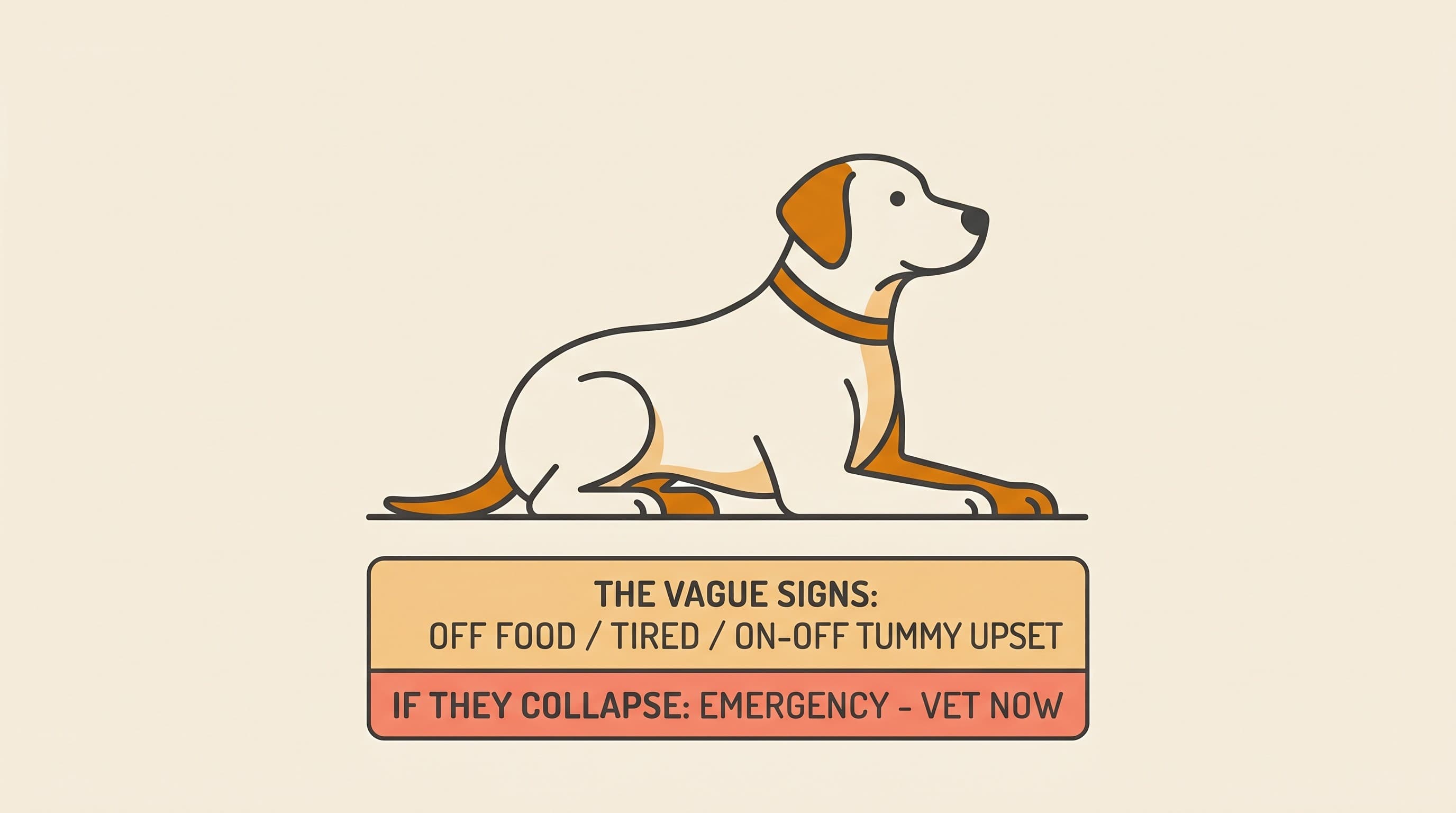
Addison's, the great pretender: vague signs that crash into a crisis
Alastair Greenway
BVM&S MRCVS
First, the one thing that can't wait
If your dog has Addison's, or you think they might, and they suddenly collapse, go profoundly weak or wobbly, start vomiting or have diarrhoea, or feel cold and look shocky, treat it as an emergency and get to a vet now. Don't wait to see if it passes.
This is what's called an Addisonian crisis, and it's the one part of this disease that's genuinely dangerous. When the adrenal glands can't keep the body's salts in balance, blood potassium can climb to a level that slows the heart, and a dog can go downhill within hours (improveinternational; Today's Veterinary Nurse). It's frightening, but it's treatable with prompt emergency care, so the right move is always speed, not a web search.
If your dog has already been diagnosed and is on treatment, your vet will have talked you through the stress-dose rule: a little extra of their steroid medication around times of illness or stress, exactly as your vet has set out (AAHA 2023). We cover how that works in the living-with-Addison's article. Keep that plan somewhere you can find it.
With that said, the rest of this piece is the calm part, because once Addison's is caught, it's one of the most rewarding hormone conditions to live with.
Why it's called "the great pretender"
Addison's disease, properly called hypoadrenocorticism, has a nickname in the veterinary world: "the great pretender" (Klein and Peterson 2010; Cornell Riney Canine Health Center). It earns it because the signs are so vague and ordinary that they look like almost anything else.
A typical story goes like this. Your dog is off their food for a day or two, maybe brings up a meal or has a soft stool, seems a bit flat, and then bounces back to normal. A few weeks later it happens again. Each episode on its own looks like a dodgy tummy, something they ate, or just an off day. The classic signs are poor appetite, low energy, weight loss, the odd bout of vomiting or diarrhoea, sometimes a bit more drinking, and general weakness (Cornell Riney; Merck Veterinary Manual). None of them point a flashing arrow at the adrenal glands.
Because of that, Addison's is regularly mistaken for other, commoner problems: inflammatory bowel disease, food poisoning, a kidney problem, even spinal or joint trouble (dvm360; BluePearl). The signs also tend to wax and wane, coming and going over weeks or months, which makes it even easier to keep explaining each flare away (Cornell Riney). It's not that anyone is being careless. It's that the disease is, by its nature, a master of disguise, and it's often only spotted once a dog becomes seriously unwell.
So if your dog has been "never quite right" for a while, with a pattern of feeling rough then recovering, Addison's is worth having on the list. It's not common, but it's very catchable, and the test to check is cheap.
What's actually going wrong
To make sense of the rest, it helps to know what the adrenal glands do. They sit just in front of the kidneys and produce two hormones that matter here.
The first is cortisol, the body's steady-state and stress hormone. It helps keep blood sugar and blood pressure stable day to day, and it's the hormone the body leans on hard whenever it's under pressure, whether that's illness, an operation, or simply a stressful day. The second is aldosterone, the salt-balance hormone, which tells the kidneys how much sodium to hold on to and how much potassium to let go (Cornell Riney; Merck Veterinary Manual).
In Addison's, the adrenal glands stop making enough of these hormones. In most affected dogs both run short, which is why two things tend to happen together. Day to day, the dog can't keep its salts balanced, so sodium drifts down and potassium drifts up. And in a crunch, the dog can't produce the surge of cortisol it needs to cope (AAHA 2023; Merck Veterinary Manual).
That second point is the key to the whole disease. A dog quietly running on empty can look more or less fine while life is calm. Then a stressor lands, a kennel stay, an infection, surgery, a long journey, and there's no reserve to call on. That's when a marginal Addison's dog can tip over into the crisis we opened with, with the dangerous potassium rise that slows the heart (improveinternational; Today's Veterinary Nurse). It's also why the disease can seem to come from nowhere, when in truth it was simmering for months.
The cheap test that should be run more often
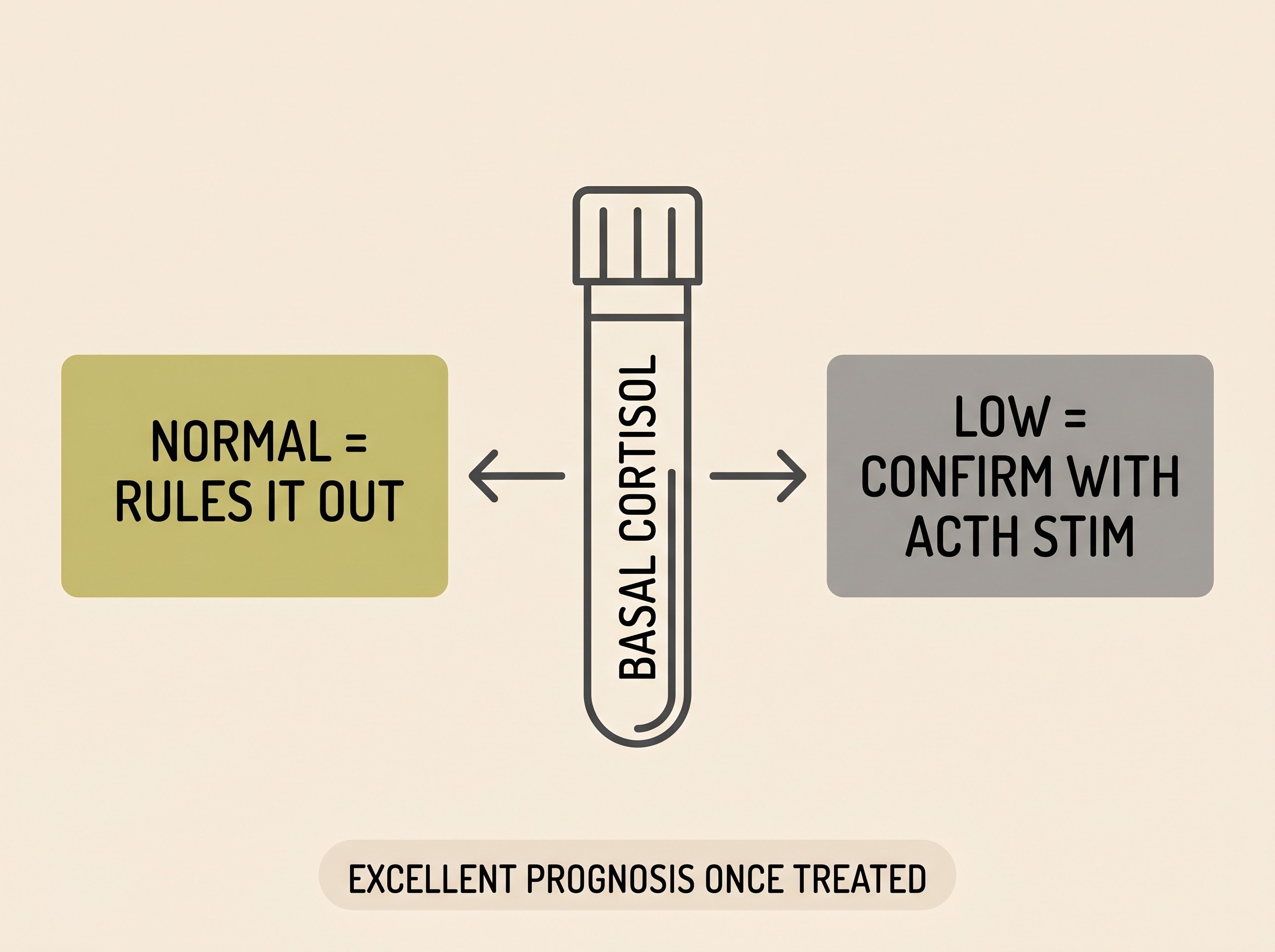
Here's the genuinely good news, and the reason we'd rather you read this before a crisis than after one. There's a simple, inexpensive blood test that can take Addison's off the table in one go: a basal cortisol, sometimes called a resting cortisol.
The logic is clean. If a dog's resting cortisol comes back clearly normal, Addison's is essentially ruled out, because a dog with failing adrenal glands can't hold a normal cortisol level (Lennon et al. 2007; Bovens et al. 2014). For a vague, on-and-off, never-quite-right dog, that's a quick, cheap way to cross one worrying diagnosis off the list and look elsewhere with confidence.
There's one important catch to understand, and it runs only one way. A normal result rules Addison's out, but a low result does not rule it in. Most dogs with a low resting cortisol turn out not to have Addison's at all (AAHA 2023; Lennon et al. 2007). So a low reading isn't a diagnosis, it's a prompt: it tells your vet to run the confirming test, called an ACTH stimulation test, which measures how the adrenal glands respond to a hormone signal and gives a definitive answer (AAHA 2023; Klein and Peterson 2010). We walk through that test, and what an actual crisis admission looks like, in the diagnosing-and-surviving-a-crisis article.
The practical takeaway: if your dog fits the picture, it's reasonable to ask your vet whether a basal cortisol is worth running. It's a small test that can save months of guesswork.
Who tends to get it
Addison's most often shows up in young to middle-aged dogs, with an average age around four to five years, and it's seen a little more often in females (Klein and Peterson 2010; AAHA 2023; Cornell Riney). That's worth knowing, because the youthfulness is part of what throws people off. A dog of three or four with a grumbling tummy doesn't immediately bring a hormone disease to mind.
It also crops up more in certain breeds, which points to an inherited tendency. Standard poodles, Portuguese water dogs, bearded collies, soft-coated wheaten terriers, West Highland white terriers, Rottweilers, Great Danes and Nova Scotia duck tolling retrievers all feature on the at-risk lists, and in a few of those breeds it does seem to run in families (Cornell Riney; Klein and Peterson 2010; Merck Veterinary Manual). The lists vary from one study to the next, so don't read too much into your dog being on or off them. The summary is simply this: a young-to-middle-aged dog that's repeatedly under the weather with no clear cause deserves the cortisol test rather than another round of guesswork.
The part that makes the diagnosis worth chasing
It would be easy to come away from a piece about a crisis feeling alarmed. So let's be clear about the ending, because it's a good one.
Once Addison's is diagnosed and the dog is stabilised on replacement hormones, the outlook is excellent. These dogs go on to live full, near-normal lives, and most have a normal life expectancy (Cornell Riney; Sherrod et al. 2025). One study reported a median survival of about five years from diagnosis, though figures vary between groups of dogs (Sherrod et al. 2025). This is not a disease you manage gloomily from one scare to the next. It's one you treat, settle, and then largely stop worrying about.
Treatment itself is lifelong but straightforward: a hormone to replace the missing salt-balance hormone, usually a roughly monthly injection or a daily tablet, plus a small daily dose of steroid to stand in for the cortisol (AAHA 2023; Cornell Riney). We cover the day-to-day of that, including the stress-dose rule and how genuinely normal life can be, in the living-with-Addison's article. The reason Addison's frightens people is almost entirely the crisis and the months of not knowing. Take those two things away, with prompt emergency care if a crisis ever hits and an early cheap test to end the guessing, and what's left is a very manageable condition.
If your dog has just been diagnosed, our printable Addison's crisis card is worth keeping on the fridge and sharing with anyone who looks after them, so the warning signs and the "go now" rule are never more than a glance away. And if your dog's main puzzle right now is drinking more than usual, our Thirst and Wee tracker can help you measure it properly, since increased thirst is one of those signs that turns up across several hormone and kidney conditions and is far more useful to your vet measured than guessed.
References
- Klein SC, Peterson ME. "Canine hypoadrenocorticism: part I." Journal of Small Animal Practice. 2010;51(2):63–69. DOI: 10.1111/j.1748-5827.2009.00859.x
- dvm360 clinical review. "Hypoadrenocorticism: the great pretender."
- Cornell University College of Veterinary Medicine, Riney Canine Health Center. "Addison's disease."
- Merck Veterinary Manual. "Addison Disease (Hypoadrenocorticism) in Animals."
- BluePearl Pet Hospital, medical library. "The Great Pretender | Canine Hypoadrenocorticism."
- 2023 AAHA Selected Endocrinopathies of Dogs and Cats Guidelines. J Am Anim Hosp Assoc 2023;59(3):113–135. DOI: 10.5326/JAAHA-MS-7368
- Improve International clinical library. "How to manage Addisonian crisis in veterinary practice."
- Today's Veterinary Nurse. "Addisonian Crisis in a Dog."
- Lennon EM, Boyle TE, Hutchins RG, et al. "Use of basal serum or plasma cortisol concentrations to rule out a diagnosis of hypoadrenocorticism in dogs: 123 cases (2000–2005)." J Am Vet Med Assoc. 2007;231(3):413–416. DOI: 10.2460/javma.231.3.413
- Bovens C, Tennant K, Reeve J, Murphy KF. "Basal serum cortisol concentration as a screening test for hypoadrenocorticism in dogs." J Vet Intern Med. 2014;28(5):1541–1545. DOI: 10.1111/jvim.12415
- Sherrod L et al. "Clinical characteristics, treatment, and outcomes of hypoadrenocorticism in dogs." Journal of Small Animal Practice. 2025. DOI: 10.1111/jsap.13870
Keep track of how your pet is doing
The owners who cope best are the ones who notice changes early. A simple health log shows you what is working, and what is not, before the next vet visit.
Start tracking, freeYou're not doing this alone
Compare treatment journeys and talk to owners managing hormone health. Free to join.
Join PetsLikeMine