

Diagnosing and surviving an Addisonian crisis
Alastair Greenway
BVM&S MRCVS
First, the emergency: when it can't wait
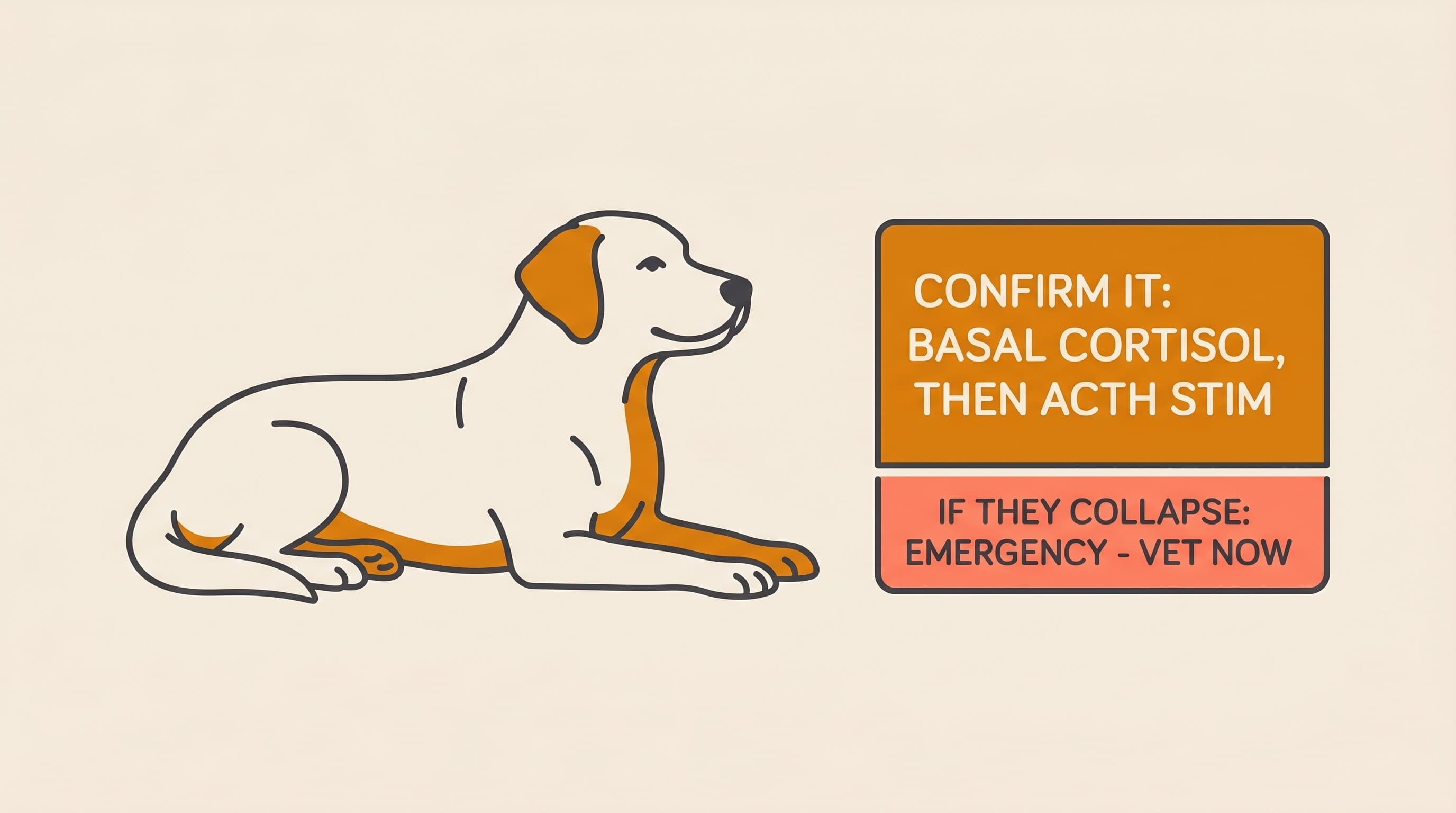
If your dog has Addison's, or you suspect they might, and they suddenly collapse, go profoundly weak or wobbly, start vomiting or have diarrhoea, or feel cold and look shocky, treat it as an emergency and get to a vet now. Don't wait to see if it passes, and don't try to fix it at home.
This is an Addisonian crisis, and it's the one genuinely dangerous part of this disease. When the adrenal glands can't keep the body's salts in balance, blood potassium can climb to a level that slows the heart, and a dog can go downhill within hours (Today's Veterinary Nurse; Improve International). It's frightening to witness, but a dog brought in promptly is very treatable, so the right move is always speed.
If your dog has already been diagnosed and is on treatment, your vet will have set out the stress-dose rule: a little extra of their steroid medication around times of illness or stress, exactly as your vet has planned it, to stop a stressful event from tipping them into a crisis in the first place (Today's Veterinary Practice). Keep that plan somewhere you can find it fast. The full how-to lives in our living-with-Addison's article.
With the emergency named, the rest of this piece is the calmer, practical part: how Addison's is actually confirmed, what a crisis admission looks like, and why the ending is usually a good one.
How Addison's is confirmed
Addison's, properly called hypoadrenocorticism, is hard to catch because its signs are so vague. Most dogs are simply flat and off their food, and many vomit or have a bout of diarrhoea, which mimics far commoner gut and kidney problems (Guzmán Ramos et al. 2022). It's also genuinely uncommon, so it isn't the first thing a vet reaches for, which is part of why it gets missed (Guzmán Ramos et al. 2022). Our great-pretender article covers that fuller picture and who tends to get it. Here, the focus is the diagnostic path itself, because it's more reassuring than most owners expect.
Step one: the cheap screen that rules it out
The first move is usually a simple, inexpensive blood test: a basal cortisol, sometimes called a resting cortisol. The logic is clean and it runs one way. If your dog's resting cortisol comes back clearly normal, above roughly 2 micrograms per decilitre (around 55 nanomoles per litre), Addison's is essentially off the table, because failing adrenal glands can't hold a normal cortisol level. At that cut-off the test catches very nearly every true case, so a normal result is a confident all-clear (Bovens et al. 2014; Guzmán Ramos et al. 2022).
Here's the catch worth understanding. A normal result rules Addison's out, but a low result does not rule it in. Plenty of dogs that are simply unwell or stressed for another reason also show a low resting cortisol, so on its own a low reading confirms nothing (Bovens et al. 2014; Guzmán Ramos et al. 2022). It isn't a diagnosis, it's a prompt: it tells your vet to run the confirming test. So the way to read this screen is "normal means not Addison's; low means go and check properly".
Step two: the ACTH stimulation test that confirms it
The test that settles it is the ACTH stimulation test, the gold standard (Guzmán Ramos et al. 2022). It's straightforward from your side. The vet takes a blood sample, gives a tiny dose of a synthetic version of the hormone that normally tells the adrenal glands to make cortisol, then takes a second sample a little later. In a healthy dog, that signal makes cortisol jump up. In an Addison's dog, there's nothing in reserve to respond with, so it stays flat and low.
A post-injection cortisol at or below about 2 micrograms per decilitre (around 55 nanomoles per litre) confirms the disease, while a result in the roughly 2 to 8 microgram range sits in a grey zone and doesn't confirm it on its own (Today's Veterinary Practice; AAHA 2023). The takeaway you need isn't the numbers, it's the shape of it: a healthy dog's cortisol leaps, an Addison's dog's barely moves.
The salt clues, and an important trap
Alongside the cortisol tests, your vet looks at your dog's electrolytes, the body's salts. The classic Addison's picture is a high potassium and a low sodium, and a sodium-to-potassium ratio below about 27 is a recognised red flag that should push the vet straight to the confirming test (Today's Veterinary Practice; Guzmán Ramos et al. 2022). It's characteristic enough to raise strong suspicion, but it's a signpost, not the diagnosis.
There's one trap that catches people out, and it cuts the other way. Roughly one in four Addison's dogs have completely normal sodium and potassium when they're diagnosed, a form vets call atypical Addison's (AAHA 2023; Guzmán Ramos et al. 2022). So normal salts do not rule the disease out. This is exactly why the cortisol tests, not the salts, are what actually settle the question, and it's another reason a vague, never-quite-right dog deserves the cortisol screen rather than a reassuring glance at an otherwise tidy blood panel.
What an Addisonian crisis looks like, and why it's so dangerous
A crisis is Addison's arriving all at once. The dog is suddenly and profoundly weak, often collapsed, usually vomiting or with diarrhoea, dehydrated, and cold or shocky to the touch (Today's Veterinary Nurse; Today's Veterinary Practice).
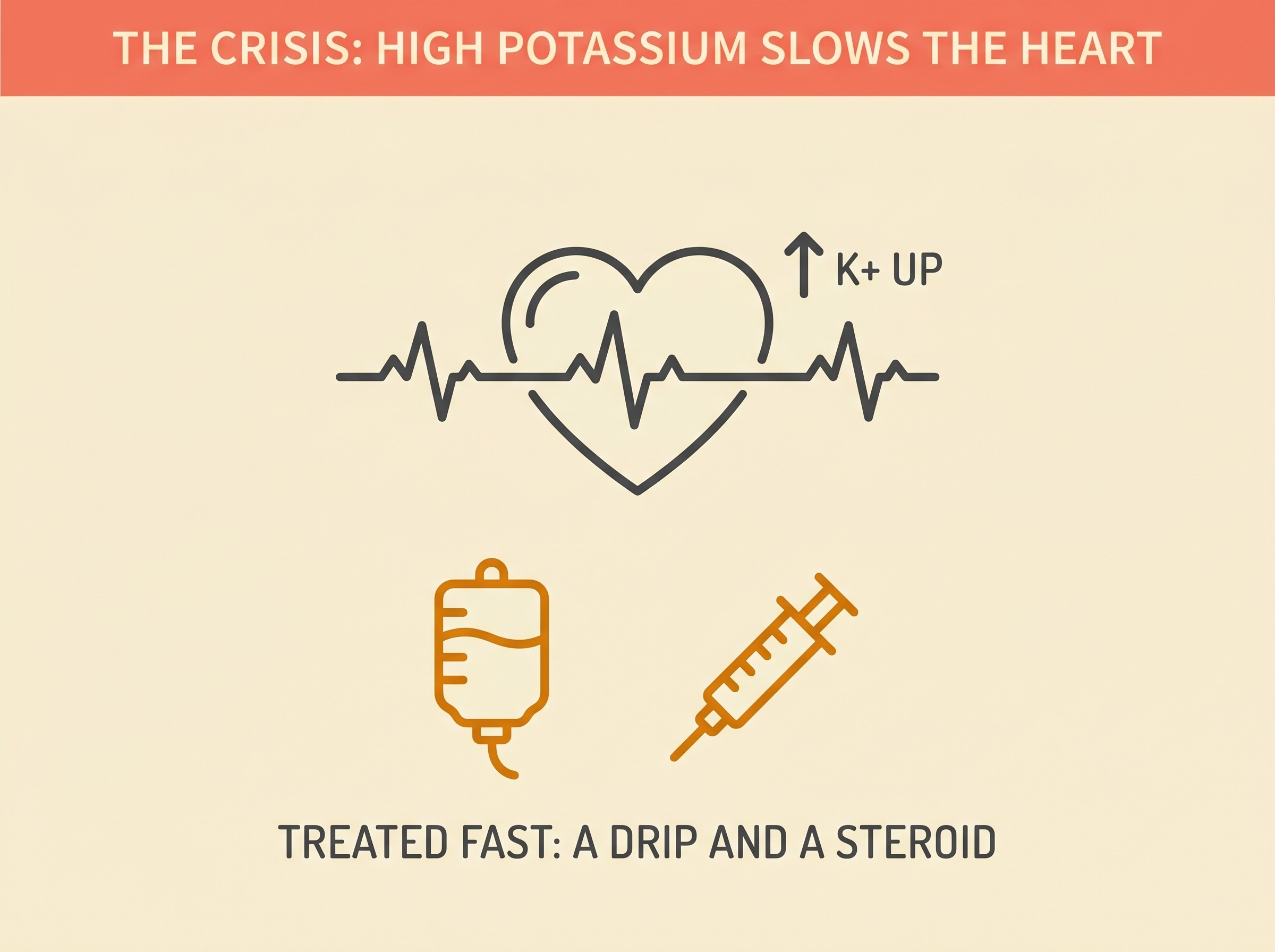
The specific danger is the potassium. With the salt-balance hormone missing, potassium builds up in the blood, and a high potassium slows the heart and can throw it into dangerous, irregular rhythms (Improve International). That's the real threat in a crisis, and it's why this is a true emergency rather than something to monitor at home: the problem isn't on the outside where you can see it, it's in the heartbeat. A stressful trigger, a kennel stay, an infection, an operation, is often what tips a marginal dog over, because there's no cortisol reserve to meet the demand.
So to say it once more, plainly: collapse, profound weakness, vomiting or diarrhoea, or a cold and shocky dog, in any dog but especially a known or suspected Addison's dog, means an emergency vet now.
Surviving it: what the vet does, and why it works
Here's the genuinely reassuring part. The emergency treatment is well established, and most dogs respond quickly (Mitropoulou et al. 2022). In owner-facing terms, it's a drip and a steroid injection, started straight away.
The drip, intravenous fluids, does the heavy lifting. It restores the blood volume the dog has lost and begins correcting those dangerous salts. Crucially, getting fluids flowing again restores blood supply to the kidneys, which lets them start clearing the excess potassium, often before any other drug has been given (Mitropoulou et al. 2022). That's why getting a crisis dog onto a drip fast matters so much. Alongside the fluids, the vet gives a fast-acting steroid to replace the cortisol the dog can't make (Mitropoulou et al. 2022; Today's Veterinary Practice).
If the potassium is high enough to be affecting the heart, the vet also has an immediate way to protect it while the fluids work, so the heart is steadied right at the start rather than left at risk (Improve International; Today's Veterinary Practice). And there's a careful detail that explains why this is firmly a hospital job and never a home remedy: a very low sodium has to be corrected slowly, because bringing it up too fast can cause serious brain injury (Mitropoulou et al. 2022). Salt or extra water at home doesn't help and can genuinely harm. The safe place for a crisis is on a vet's drip, where the correction is controlled.
The ending is a good one
It would be easy to finish a piece about a crisis feeling shaken, so let's be clear about how this usually goes, because it's one of the most rewarding turnarounds in canine medicine.
Once a dog is through the crisis, diagnosed and stabilised on replacement hormones, the prognosis is excellent (AAHA 2023; Lathan and Thompson 2018). These dogs go on to live full, near-normal lives. One recent study reported a median survival of about 5.6 years from diagnosis, with an overall lifespan comparable to dogs as a whole, and most Addison's dogs eventually die of something entirely unrelated (Sherrod et al. 2025). This isn't a condition you manage anxiously from one scare to the next. It's one you treat, settle, and then largely stop worrying about. The day-to-day of that, the monthly injection or daily tablets, the small daily steroid and the all-important stress-dose rule, is covered in our living-with-Addison's article.
If your dog has just been diagnosed, our printable Addison's crisis card is worth keeping on the fridge and sharing with everyone who looks after them, so the warning signs and the "go now" rule are never more than a glance away. And if the puzzle right now is that your dog seems to be drinking more than usual, our Thirst and Wee tracker helps you measure it properly, since increased thirst turns up across several hormone and kidney conditions and is far more useful to your vet measured than guessed.
References
- Guzmán Ramos PJ, Bennaim M, Shiel RE, Mooney CT. Diagnosis of canine spontaneous hypoadrenocorticism. Canine Med Genet. 2022;9:6.
- Bovens C, Tennant K, Reeve J, Murphy KF. Basal serum cortisol concentration as a screening test for hypoadrenocorticism in dogs. J Vet Intern Med. 2014;28(5):1541-1545.
- Mitropoulou A, Häuser MK, Lehmann H, Hazuchova K. Comparison of Hydrocortisone Continuous Rate Infusion and Prednisolone or Dexamethasone Administration for Treatment of Acute Hypoadrenocortical (Addisonian) Crisis in Dogs. Front Vet Sci. 2022;8:818515.
- Sherrod et al. Clinical characteristics, treatment, and outcomes of hypoadrenocorticism in dogs. J Small Anim Pract. 2025.
- 2023 AAHA Selected Endocrinopathies of Dogs and Cats Guidelines: Canine Hypoadrenocorticism (Addison's Disease). American Animal Hospital Association.
- Lathan P, Thompson AL. Management of hypoadrenocorticism (Addison's disease) in dogs. Vet Med (Auckl). 2018;9:1-10.
- Galati G, Lathan P. Diagnosis and Management of Hypoadrenocorticism in Dogs. Today's Veterinary Practice.
- How to manage Addisonian crisis in veterinary practice. Improve International clinical library.
- Addisonian Crisis in a Dog. Today's Veterinary Nurse.
Keep track of how your pet is doing
The owners who cope best are the ones who notice changes early. A simple health log shows you what is working, and what is not, before the next vet visit.
Start tracking, freeYou're not doing this alone
Compare treatment journeys and talk to owners managing hormone health. Free to join.
Join PetsLikeMine