

Acromegaly and insulinoma: a signpost (owned by the Diabetes space)
Alastair Greenway
BVM&S MRCVS
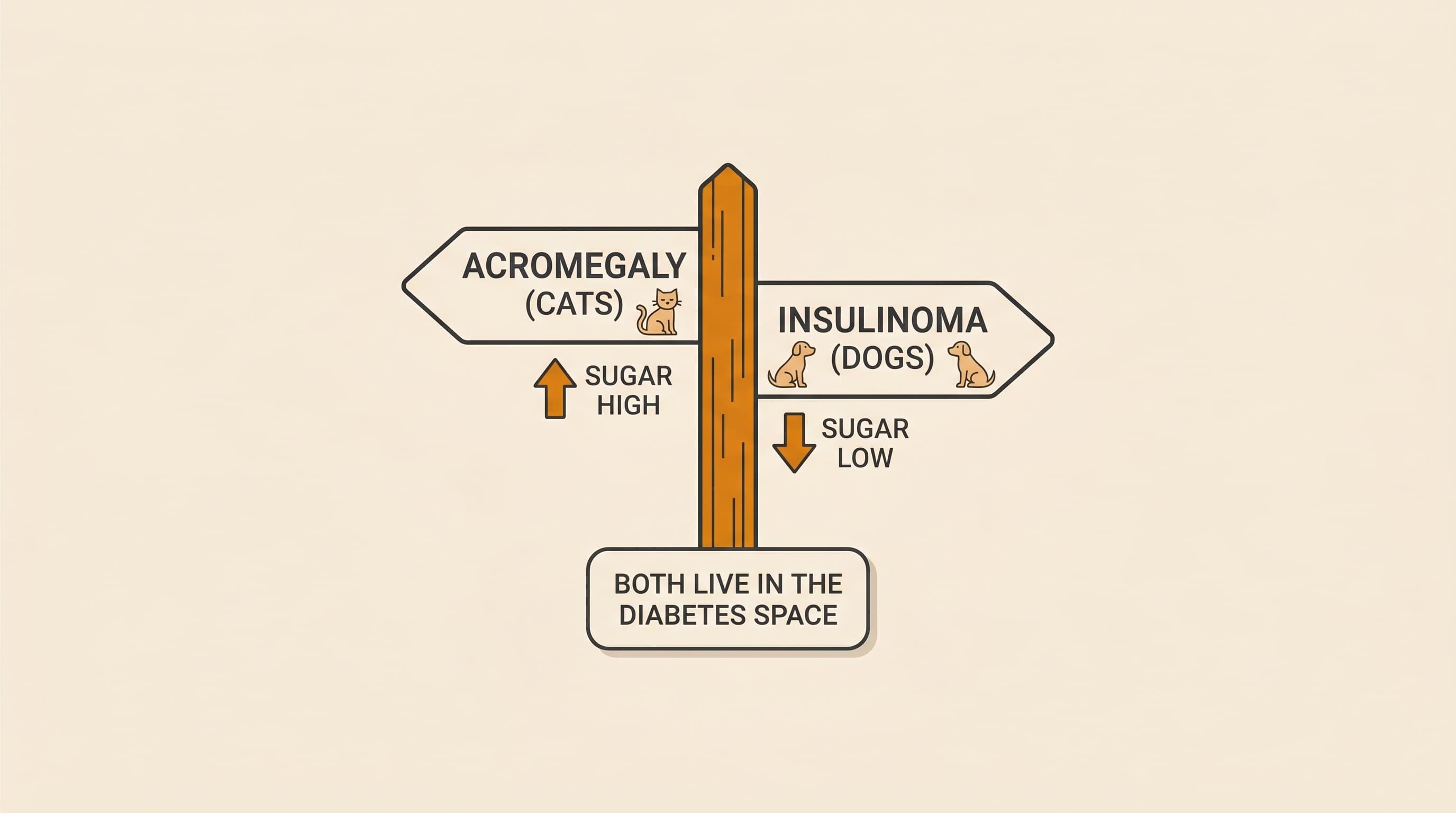
This is a short one. Two conditions get a mention in this Hormone Health home but live properly in the Diabetes space, because both are really about blood sugar and insulin. If your vet has named one of them, or you've come across the word and want a calm sense of what it means, this is your map. It isn't a full management guide, and it doesn't need to be, because the deeper track for each one sits with the Diabetes space, where it belongs.
The two of them sit on opposite ends of the same problem. Acromegaly is a hidden reason a diabetic cat won't settle on insulin, so it pushes the sugar the wrong way (too high). Insulinoma is the mirror image, a tumour that makes too much insulin, so the sugar drops too low. One leans heavily towards cats, the other heavily towards dogs. So when we say "both species" here, we mean the pair covers both, not that each condition hits both equally.
Acromegaly: the cat whose diabetes won't behave
Acromegaly in cats is caused by a small tumour on the pituitary gland in the brain that makes far too much growth hormone (Niessen et al. 2015). You might also hear it called hypersomatotropism, which is just the medical name for that growth-hormone excess.
The bit that matters day to day is what all that growth hormone does to insulin. It makes the cat's body resist insulin, so it shows up as diabetes that's hard to control, with the cat still running high on doses that should have settled things (Niessen et al. 2015). That's the real hook, and it's why this belongs with diabetes: acromegaly is one of the main reasons a diabetic cat won't come under control on insulin. Vets at Washington State University describe a cat needing more than 1.5 units of insulin per kilogram per dose and still staying high as insulin-resistant, with a pituitary growth-hormone tumour as one cause to look for (WSU 2022).
It's also more common than vets used to think. In a large UK study that screened diabetic cats, around a quarter, roughly 1 in 4, had it (Niessen et al. 2015). That's a striking number, and it's worth saying plainly: this isn't an exotic rarity, it's a regular reason a diabetic cat struggles.
Here's the part that surprises owners most. Most acromegalic cats don't look acromegalic. The dramatic textbook picture, the broadening face, the heavier jaw, the bigger paws, is often absent or so subtle you'd never spot it. In the UK study most cats showed none of the classic features (Niessen et al. 2015). So you usually can't see it. It's found on a blood test in a diabetic cat that won't stabilise, not by looking at the cat.
That blood test is an IGF-1, run in a diabetic cat, and a high result points the way to pituitary imaging (a CT or MRI scan) to confirm it (Niessen et al. 2015; MSD Veterinary Manual). If there's one sentence to take from this section, it's this: if your diabetic cat is hard to control, ask your vet about the IGF-1 test. The level can read a bit oddly very early on, or before insulin's been started, so your vet may repeat it rather than rely on a single number.
This is the calm steer rather than an alarm. A diabetic cat that won't control deserves to be investigated, not just pushed onto more and more insulin indefinitely, because a hidden cause like acromegaly may be why it isn't working, and escalating blindly risks dangerous swings. Ask why it isn't settling.
And the genuinely reassuring part: it's treatable, and the diabetes can resolve. Removing or shrinking the pituitary tumour, by surgery (hypophysectomy) or radiotherapy, or treating it medically, can bring the growth hormone back down and let the diabetes ease. In one surgical series, growth-hormone excess resolved in 23 of 24 cats and the diabetes resolved in 22 of 24, with most cats living for years afterwards (Fenn et al. 2021). Cats given a treatment aimed at the cause have tended to live longer than cats kept on insulin alone (Corsini et al. 2022). So some cats even come off insulin. We'll keep it to that one line of good news here, because the full treatment picture is the Diabetes space's job.
One quick note so dog owners aren't misled. Dogs can get acromegaly too, but it's a different and rarer story, usually driven by the hormone progesterone (the natural seasonal cycle in an unspayed bitch, or progestogen injections) with the growth hormone coming from the mammary tissue rather than a pituitary tumour (Fracassi review; Selman et al. 1994). It's handled differently, and that's as far as we'll take it here.
Insulinoma: the dog whose sugar drops too low
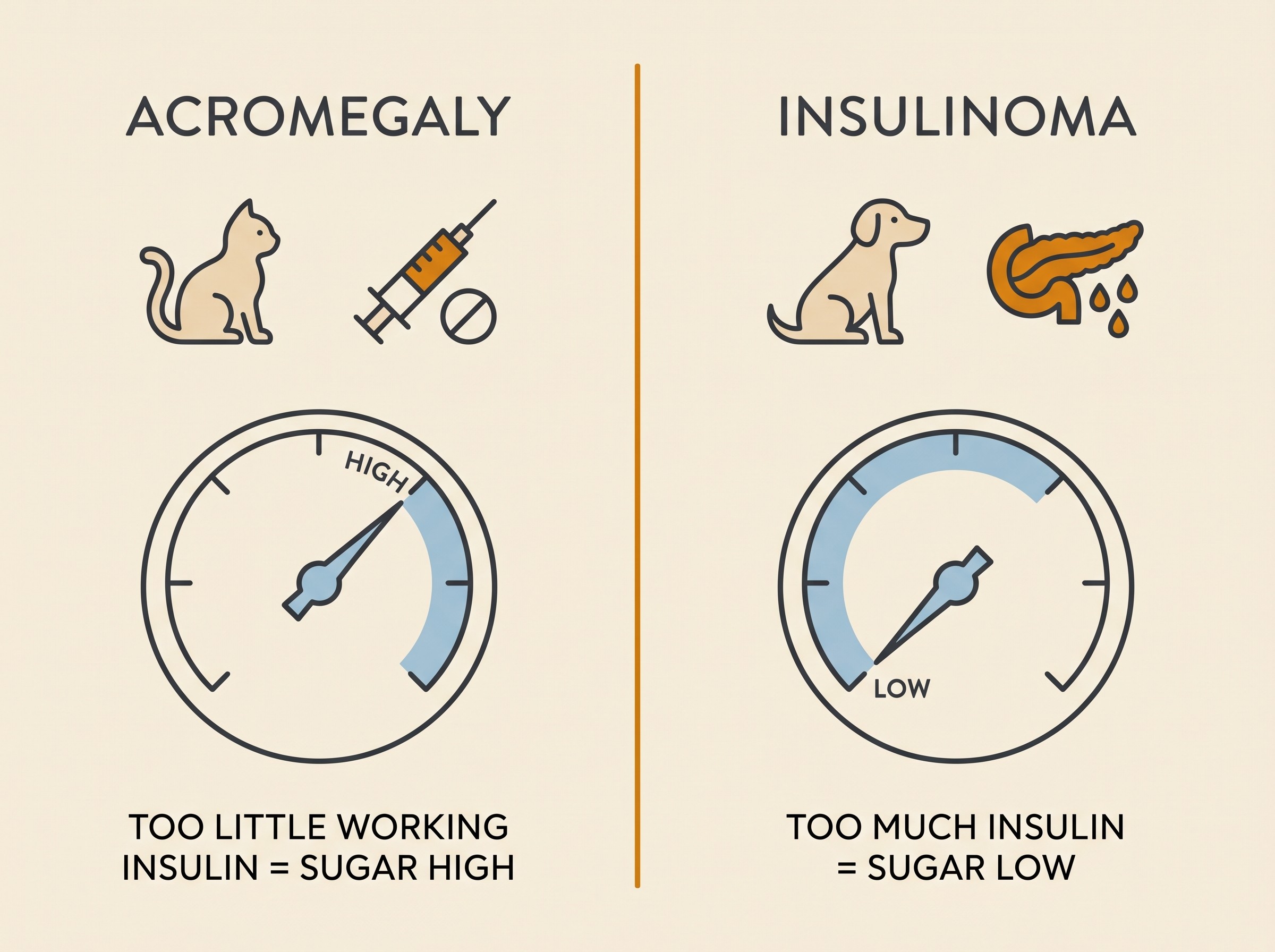
Insulinoma runs the opposite way. It's a tumour of the insulin-making beta cells of the pancreas that secretes too much insulin, so the blood sugar falls too low (Buishand 2022). That's the cleanest way to hold the two side by side: diabetes is too little working insulin and high sugar, while insulinoma is too much insulin and low sugar. Same machinery, opposite fault, which is exactly why it sits next to the diabetes hand-off.
This one's a dog's disease. It's the commonest tumour of the pancreas in dogs, typically in middle-aged to older medium and large breeds (Buishand 2022). It's uncommon even in dogs, and in cats it's a genuine rarity, with only a handful of feline cases ever reported (Buishand 2022; EveryCat). So picture a dog here.
The signs come from the brain being starved of sugar. That means weakness, wobbliness or collapse, changes in behaviour or consciousness, and seizures, alongside shakiness, hunger and restlessness as the body's adrenaline kicks in to try to lift the sugar (Buishand 2022). In one study of 116 affected dogs, the commonest signs were weakness in about 60%, seizures in about a third, and changes in behaviour or consciousness in roughly a quarter (Ryan et al. 2021).
That seizure figure is worth pausing on. Because around a third of these dogs first show up with seizures, insulinoma is one of the things a vet checks for in an older dog with new "fits". It can look like epilepsy, but the cause is low blood sugar, which is why your vet will check a blood glucose in a seizing older dog rather than assume epilepsy straight away. (Our Epilepsy space covers seizures more broadly if that's where your worry started.)
One safety line, and it's a real one. If a dog with insulinoma collapses or has a seizure, rub a sugar source (honey or glucose syrup) onto the gums and ring the vet straight away, because the low blood sugar itself is the immediate danger. Gums and lips only. Don't try to pour food or liquid down the throat of a dog that's seizing or unconscious, as it can go down the wrong way.
Diagnosis comes down to catching a low blood sugar at the same moment as an insulin level that's still switched on, when it should have switched off (Buishand 2022). Your vet may mention Whipple's triad, which is just a tidy way of saying the same thing: the signs appear, the sugar is low when they do, and the signs ease when sugar is given (Buishand 2022). You don't need the term, but you might hear it.
It's worth being calm but straight about. Most canine insulinomas are malignant and tend to spread, so it's taken seriously, with the field regarding more than 95% as malignant (Buishand 2022). That sounds heavy, but it's treatable and many dogs have good quality time. Surgery to remove the tumour gives the best results, and dogs without spread can do well for a year or more, while medical management (small frequent meals, then a drug called diazoxide, sometimes with steroids) controls the low sugar when surgery isn't an option (Buishand 2022; Today's Veterinary Practice). Survival figures vary a lot, but dogs treated with surgery have generally done better than those managed with medication alone, sometimes by a good margin (Buishand 2022; Ryan et al. 2021). Your vet, and the Diabetes space, will walk you through which path fits your dog.
Where to go next
That's the short version of both. They're here so you've got the name and a calm sense of what's going on, but the full management, the testing detail, the treatment choices and the day-to-day living, lives in the Diabetes space, because both are sugar diseases at heart. If your cat's diabetes won't settle, or your dog has been diagnosed with an insulinoma, head over to the Diabetes space for the full picture. And if it's the thirst and weeing that first sent you looking, the Thirst & Wee tracker can help you measure what's actually changing while you and your vet work it out.
References
- Niessen SJM, Forcada Y, Mantis P, Lamb CR, et al. "Studying Cat (Felis catus) Diabetes: Beware of the Acromegalic Imposter." PLoS One. 2015;10(5):e0127794.
- Washington State University Veterinary Teaching Hospital. "Insulin-dependent diabetic cat study." 2022.
- MSD/Merck Veterinary Manual. "Acromegaly in Cats."
- Fenn J, Kenny PJ, Scudder CJ, Hazuchova K, et al. "Evaluation of hypophysectomy for treatment of hypersomatotropism in 25 cats." J Vet Intern Med. 2021.
- Corsini A, Niessen SJM, Miceli DD, Caney S, et al. "Quality of life and response to treatment in cats with hypersomatotropism: the owners' point of view." J Feline Med Surg. 2022.
- "Acromegaly in dogs and cats" (review). Domestic Animal Endocrinology.
- Selman PJ, Mol JA, Rutteman GR, et al. "Progestin-induced growth hormone excess in the dog originates in the mammary gland."
- Buishand FO. "Current Trends in Diagnosis, Treatment and Prognosis of Canine Insulinoma." Veterinary Sciences. 2022;9(10):540.
- EveryCat Health Foundation. "Insulinoma in a Cat."
- Ryan D, Pérez-Accino J, Gonçalves R, et al. "Clinical findings, neurological manifestations and survival of dogs with insulinoma: 116 cases (2009–2020)." J Small Anim Pract. 2021.
- "Canine Insulinoma: Diagnosis, Treatment, and Staging." Today's Veterinary Practice.
Keep track of how your pet is doing
The owners who cope best are the ones who notice changes early. A simple health log shows you what is working, and what is not, before the next vet visit.
Start tracking, freeYou're not doing this alone
Compare treatment journeys and talk to owners managing hormone health. Free to join.
Join PetsLikeMine